Enno Janssen and Entje Tejen b. 1810

Enno and Entje Janssen, my 4th great grandparents on RootsMagic tree

Enno Hinrichs Janssen was born in 1810 and Entje Tejen was born in 1812. They married, attended church and raised their family in Eilsum, a village in Krummhorn, a municipality in the district of Aurich, in Lower Saxony, Germany. Eilsum is at the northernmost edge of Germany. Eilsum, in the Middle Ages about 500-1500, was a ‘super regional trading center’ on the Wadden Sea, and the North Sea. The area for a long time was known as East Frisia, Ostfriesia. My grandpa Roose’s ancestors, so far, are all from this area in Germany, of about 1000 square miles.

At FamilySearch.org, a free online family history site with billions of historical records recently added big batches of “Germany, Lutheran Baptisms, Marriages, and Burials, 1500-1971” records. The records are handwritten in the German language, indexed by volunteers who transcribe then translate the records into English. These records led to many Roose family ancestors. The only record, so far for Enno and Entje is their marriage record of 1833. It’s likely they didn’t live to see their daughter, Kuna, in 1883 at age 50 migrate to America, where she, husband Casjen Frerichs , and kids made their home in Butler County, Iowa.

The Janssen family’s Eilsumer Church was built around 1230 with major renovations in the 1990s. The baptismal font was made by, “Barthold Klinghe the Elder, 1472, Four deacons carry the basin, on the wall of which Christ, Mary and the apostles appear.” The Klinghes were famous for their ‘bronze casting’.

Sources

William Wilson and Mary Pierce b. 1660

William Wilson and Mary Pierce, my 8th great grandparents on RootsMagic tree

William Wilson was born around 1660 in Charlestown, Massachusetts to Edward Wilson and Mary Hale. William’s dad Edward and his uncle John Hale were Puritan ministers. John Hale was famous in the Salem witch trials and afterwards wrote a book about his involvement & thoughts. “A Modest Inquiry into the Nature of Witchcraft, in which he suggested the fear of witchcraft was so great that it impaired the judgment of everyone involved in the trials, possibly resulting in the death of innocent people.”

Mary Pierce was born in Boston, Massachusetts on March 13, 1661. “Boston Records Births, Pearse Mary ye Daughter of John Pearse and of Isabell his wife borne 13 March 1661”. Her parents, John and Isabell Pierce, could have been born in America or England. There are not a lot of records for Mary Pierce.

William and Mary were married on October 1, 1685 in Charlestown. “William Wilson and Mary Pearce of Boston married by Humphry Davies Esq. Oct 1, 1685.” Mary and William had two kids: Samuel and Mary. William was a woodworker, he made chairs and was a turner, using a lathe to make bowls and candlesticks.

William Wilson in U.S., Craftperson Files, 1600-1995 at Ancestry.


In September of 1695 William and his neighbors learned a bridge was being built near their road. They were against this bridge, to stop it they threw lots of logs, stones and lumber onto the road. They were called to the Boston Court on September 30, 1695. The Court ordered them to remove ‘nuisances and annoyances’ by October 1 or the men would all pay fines. There’s no final court record with further fines or issues so it all must have worked out.

William wilson and neighbors didn;t want the bridge, A Report of the record commissioners of the city of Boston at HathiTrust


William died in 1732 in Boston, Mary’s death date in unknown. When William Wilson died, his son in law Samuel Connable, husband of Mary Wilson was the estate administrator. Samuel and Mary’s 2nd great granddaughter Leydia Connable, moved west from Massachusetts to Indiana, then to Dunkerton, Iowa in 1854.

Sources

John Witter b. 1677

John Witter 8th great grandpa on RootsMagic tree

John Witter was born on March 11, 1677 in New London, Connecticut. His grandparents arrived from England in the 1630s. His parents Sarah Crandall and Josiah Witter shared a history when on July 21, 1651 preachers “John Clarke, John Crandall, and Obadiah Holmes, came from Newport, and went to the house of William Witter”, at Swampscot, Massachusetts. The preachers administered the sacrament, and re-baptized Witter. Their illegal acts were reported, constables came, and the preachers were arrested for disturbing the peace, put in a Boston prison and ordered to pay a fine. It was illegal to hold Baptist services, in that place and time.

John Witter married Sarah Tefft in 1703, They settled in Westerly, Rhode Island, also Misquamicutt and Hopkinton, where they were both members of the First Sabbatarian Church, which turned in to the Seventh-day Baptist church. On February 28, 1710 John received a grant of 203 acres, on January 24, 1715 he mortgaged 101 acres and on December 22, 1743 he deeded 92 acres to his “Son John Witter Junr.”

John was a widow in 1720, he married a 2nd wife Mary. John died in August 1757 in Westerly, Rhode Island and is probably buried with both his wives at Witter Cemetery, also called First Hopkinton Cemetery near where the original Sabbatarian Church Cemetery stood.

Sources

Crusades 1095

… a series of military campaigns launched by the papacy between 1095 and 1291 against Muslim rulers for the recovery and defence of the Holy Land (Palestine), encouraged by promises of spiritual reward. At Wikipedia https://en.wikipedia.org/wiki/Crusades

Also the Crusading movement, theoretical, sociological, institutional, military, and financial dimensions of crusading. https://en.wikipedia.org/wiki/Crusading_movement

And Voltaire wrote of the “madness of the crusades”, driven by religious intolerance defined by misery and death.

Francis of Assisi before Sultan al-Kamil during the Fifth Crusade (15th-century fresco by Benozzo Gozzoli)

Saer de Quincy b. 1155

This ancestor is fairly new to my tree. Saer de Quincy, 1st Earl of Winchestter, a baron, a knight who fought alongside kings, a keeper of the Magna Carta. He was born around 1155 and died on November 3, 1219 in Damietta, Egypt.

After his work on the Magna Carta, in 1219 de Quincy joined the crusaders with a vow to capture Jerusalem and holy artifacts from Egypt, Fifth Crusade at Wikipedia- 131 footnotes and links. The first [of thousands] of western European crusaders landed on the Nile in May 1219, at Damietta which after months of battle was captured on November 5, 1219.

de Quincy died on November 3, 1219, of illness, days before the Damietta capture. He was buried in Jerusalem and heart or maybe some ashes were returned to England, interred at Garendon Abbey which no longer exists.

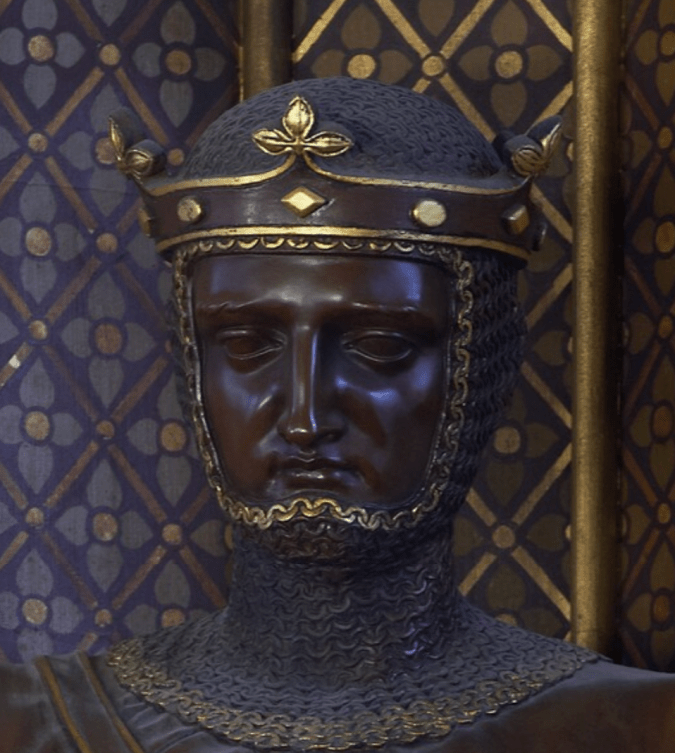
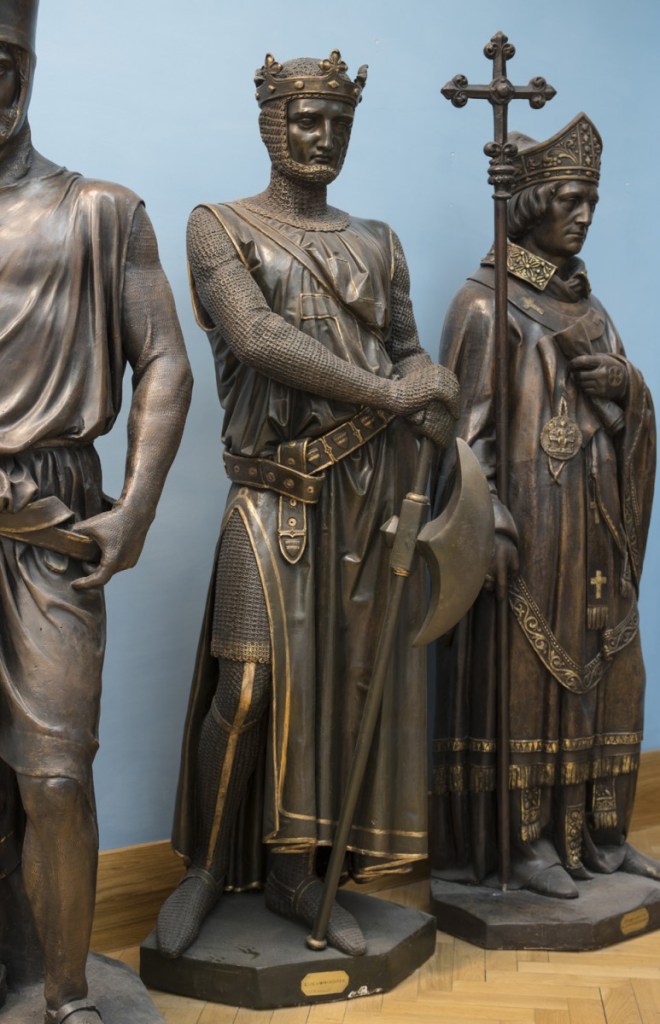
Saer de Quincy has two fantastic memorials.

Baron Saher de Quency (d.1219), Earl of Winchester, Appointed to Secure the Observance of the Magna Carta", via ArtUK website
A closeup in the “Parliamentary Art Collection” at Heritage Collections at UK Parliament, Baron Saher de Quency (d.1219), Earl of Winchester, Appointed to Secure the Observance of the Magna Carta.
"A life-size figure of Saher de Quincy, Earl of Winchester, with crown and axe. This is a prototype for the equivalent bronze statue in the House of Lords", via ArtUK website.
At ArtUK, “A life-size figure of Saher de Quincy, Earl of Winchester, with crown and axe”.

Magna Carta, a king is not above the law

“Magna Carta … issued in June 1215 … put into writing … that the king was not above the law … placed limits by establishing law as a power in itself” via UK Parliament.

Magna Carta in Latin is ‘great charter’. The Magna Carta has a long history. America and other countries borrowed from the charter when setting up their governments, guaranteeing rights to the people, denying kings and leaders unlimited power.

I was reminded of the Magna Carta while reviewing Ann Mainwaring and Richard Charlton, my 14th great grandparents. 200 years after the Magna Carta, Ann and Richard lived in western England, in Shropshire, near the border of Wales. Richard Charlton’s ancestry is in the book, The Magna charta sureties, 1215; the barons named in the Magna charta, 1215, and some of their descendants who settled in America, 1607-1650. He’s a descendant, number 12 in a line of barons, of Saer de Quincy, 1st Earl of Winchestter, “a leader of the First Barons’ War against King John” and probably my 22nd great grandpa.

I wish I’d known this relationship while studying history in high school.

The Magna Carta was born out of baron rebellions. Land owners rebelled against King John and his protectors. King John was despised, had an awful personality and was a lazy and corrupt King. He taxed the barons and gave them nothing in return so there were uprisings and murder plots, then a standoff, then the Magna Carta was signed but blocked by the pope, more battles followed, support for the king declined until his death in 1216. King John’s Henry at nine years old was made King. The Magna Carta was approved and finally “repeatedly confirmed and reissued and became well-known across England, not just among the barons, but also in the counties”.

Wikipedia links to royal bios and history

The Magna Charta Sureties, 1215: the Barons Named In the Magna Charta, 1215, And Some of Their Descendants Who Settled In America, 1607-1650 book at HathiTrust. 138 pages “considered a foundational and historically important genealogy source”, but published in 1955 cross checking with current research is recommended.

Matilda Flood b. 1858

Matilda Flood, my 2nd great grandma on RootsMagic tree

Matilda Elizabeth Flood was the oldest daughter of William and Delia Angell Flood. She was born in Shell Rock, Iowa in Butler County on February 26, 1858. Her family lived on a farm, she had 4 sisters and 2 brothers. On March 2, 1883 Matilda married Richard Mockford. They farmed near Allison and had 2 daughters plus a son who died as an infant.

On February 28, 1907 maybe as birthday party for Matilda, “Mr. and Mrs. Mockford were completely surprised Friday evening, when a party of their neighbors and friends dropped in on them in a body to spend the evening. Though surprised, they were equal to the occasion, and very gladly joined in to make the evening a most enjoyable one. After participating in games and various amusements for a time, a dainty lunch was served and when the guests departed for their several homes, we can say on good authority that it was not a very early hour.”

Matilda was a widow in 1910. In 1931 on her 73rd birthday, her friends and family held another surprise party for her. Matilda lived on her own from age 52 to her 70s, then with a grandson until her death at age 82. Daughter Philippa and family lived close by. Matilda is buried at Lowell Cemetery in Allison, Iowa.

Sources

James Brown b. 1655

James Brown 8th great grandpa on RootsMagic tree.

James Brown was born on May 4, 1655 in Rehoboth, Massachusetts. His grandparents John Howland and Elizabeth Tilley were on the Mayflower, married and had 10 children, with millions of descendants today. Elizabeth lived with James and family from 1687 to 1673 and would have shared her stories of the Mayflower and those first years in colonial America.

John married Margaret Dennison on June 5, 1678, and they had at least 10 children. James was known as a Lieutenant in the ‘militia’, the history of his service is lost. He could have been in one the biggest battles of the time, the Great Swamp Massacre of December 1675, recently in the news, the sacred land has been returned to the Narragansett Indians.
https://thepublicsradio.org/article/site-of-great-swamp-massacre-returned-to-narragansett-indian-tribe

James wrote his will June 28, 1717 and died on April 15, 1718 . “James Brown of the Town of swanzey In the County of Bristol In his majesties Provence of the massachusets Bay In Newengland yeoman ; Being Crazie of Body but of Perfect minde and memory Thanks be Given to God … Do make & ordain this my Last will & Testement. The oldest son James received the family farm, upland & meadows, -with this Reserve that my wife margrett Brown have the use of all the meadow I now make use of Dureing her Naturall Life or widdowhood”. Younger sons received other lands, daughters received money. James’s inventory included clothing, housewares, looms and yarns, livestock, rights to the sawmill and more.

James is buried at Ancient Little Neck Cemetery, on the Providence River. His headstone is there, inscribed with, “In Memory of Lieut. JAMES BROWN who Died April 15th 1718 in the 60th Year of his Age”. Many of James’s family are buried there too including his grandma, Elizabeth Tilley Howland.

Sources

John Smith and Marah Huntley b. 1660

John Smith and Marah Huntley 8th great grandparents on RootsMagic tree.

Marah, or Mary, Huntley was born on December 3, 1660 in Lyme, Connecticut.- a new record shows Marah born in Roxbury, Massachusetts. The date is definite- the place is not. She was the 4th child of John and Jane Huntley. Her dad John Huntley would sail to Barbados, where he traded fish for tobacco and cotton. A record shows he bought a pair of shoes and a shirt for his wife on one trip. He probably bought back gifts for his kids too.

John Smith was born November 20, 1655 in Massachusetts, to Richard and Joanna Quarlls Smith who were both from England, and married in Boston. John and his family moved to Lyme Connecticut soon after John’s birth. In Lyme, on October 26, 1685 John and Marah married. They had at least 10 kids and stayed in the Lyme, New London, Connecticut area.

Before they married, John Smith, his dad and Marah’s dad, both their grandads, and future in laws were part of the Lyme Riot of August 1671. New London and Lyme, Connecticut, towns next to each other, had a history of land disputes. In 1671 men from both towns fought over mowing the minister’s meadows. 30 men from New London wanted to mow, a group of men from Lyme set out to do the same, and the riot started. After a while leaders from both towns met and “drinking a dram together with som(e) seeming friendship, every man departed to his home”. The men were fined, the courts eventually covered the fines.

John Smith died in Lyme, Connecticut on October 11, 1736. Marah Huntley Smith died soon after.

Sources

Benjamin Child b. 1631

Benjamin Child 9th great grandpa on RootsMagic tree.

Benjamin Child was born in 1631 in Cotesbach, Leicestershire, England. Some family trees state this Child family has “genealogy going back to William the Conqueror”. There’s no records to show this.

Benjamin was 3 when his dad died. His uncle Ephraim Child left England for America and probably convinced his nephew to migrate too. By 1652 Benjamin was in Roxbury, Massachusetts and married to Mary Bowen. Benjamin and Mary had 12 kids. They were members of the First Church of Roxbury. “In the records of Roxbury, Mr. Benjamin Child is stated to have been of the thirty who contributed for the erection of the First Church of Roxbury.” Roxbury was a town in the 1600s, today it’s a Boston neighborhood.

Inventory, Genealogy of the Child, Childs and Childe families

Benjamin died on October 14, 1678 in Roxbury. He didn’t have a will. His estate was settled in May of 1679 and included an inventory with a house and barn, 92 acres of land, “money in the House and in good hands”, 3 silver spoons, a wine cup, a trundle bed, wearing clothes, blankets and rugs; and more.

Benjamin is most likely buried at Eliot Burying Ground Cemetery “one of the three oldest [cemeteries] in Boston” named for John Elliot “Apostle to the Indians” and founder of Roxbury. The cemetery is next to a former fire station, “The Eustis Street Firehouse, the oldest standing firehouse in Boston”, and a few yards east of Benjamin’s church, the First Church of Roxbury.

Benjamin’s granddaughter Grace married Timothy Walker, whose granddaughter Cynthia married Asa Angell. Asa’s great granddaughter Matilda Flood in Iowa married Richard Mockford and their great granddaughter Elizabeth was born in Iowa in 1917.

Sources