William Wilson and Mary Pierce b. 1660

William Wilson and Mary Pierce, my 8th great grandparents on RootsMagic tree

William Wilson was born around 1660 in Charlestown, Massachusetts to Edward Wilson and Mary Hale. William’s dad Edward and his uncle John Hale were Puritan ministers. John Hale was famous in the Salem witch trials and afterwards wrote a book about his involvement & thoughts. “A Modest Inquiry into the Nature of Witchcraft, in which he suggested the fear of witchcraft was so great that it impaired the judgment of everyone involved in the trials, possibly resulting in the death of innocent people.”

Mary Pierce was born in Boston, Massachusetts on March 13, 1661. “Boston Records Births, Pearse Mary ye Daughter of John Pearse and of Isabell his wife borne 13 March 1661”. Her parents, John and Isabell Pierce, could have been born in America or England. There are not a lot of records for Mary Pierce.

William and Mary were married on October 1, 1685 in Charlestown. “William Wilson and Mary Pearce of Boston married by Humphry Davies Esq. Oct 1, 1685.” Mary and William had two kids: Samuel and Mary. William was a woodworker, he made chairs and was a turner, using a lathe to make bowls and candlesticks.

William Wilson in U.S., Craftperson Files, 1600-1995 at Ancestry.


In September of 1695 William and his neighbors learned a bridge was being built near their road. They were against this bridge, to stop it they threw lots of logs, stones and lumber onto the road. They were called to the Boston Court on September 30, 1695. The Court ordered them to remove ‘nuisances and annoyances’ by October 1 or the men would all pay fines. There’s no final court record with further fines or issues so it all must have worked out.

William wilson and neighbors didn;t want the bridge, A Report of the record commissioners of the city of Boston at HathiTrust


William died in 1732 in Boston, Mary’s death date in unknown. When William Wilson died, his son in law Samuel Connable, husband of Mary Wilson was the estate administrator. Samuel and Mary’s 2nd great granddaughter Leydia Connable, moved west from Massachusetts to Indiana, then to Dunkerton, Iowa in 1854.

Sources

John Witter b. 1677

John Witter 8th great grandpa on RootsMagic tree

John Witter was born on March 11, 1677 in New London, Connecticut. His grandparents arrived from England in the 1630s. His parents Sarah Crandall and Josiah Witter shared a history when on July 21, 1651 preachers “John Clarke, John Crandall, and Obadiah Holmes, came from Newport, and went to the house of William Witter”, at Swampscot, Massachusetts. The preachers administered the sacrament, and re-baptized Witter. Their illegal acts were reported, constables came, and the preachers were arrested for disturbing the peace, put in a Boston prison and ordered to pay a fine. It was illegal to hold Baptist services, in that place and time.

John Witter married Sarah Tefft in 1703, They settled in Westerly, Rhode Island, also Misquamicutt and Hopkinton, where they were both members of the First Sabbatarian Church, which turned in to the Seventh-day Baptist church. On February 28, 1710 John received a grant of 203 acres, on January 24, 1715 he mortgaged 101 acres and on December 22, 1743 he deeded 92 acres to his “Son John Witter Junr.”

John was a widow in 1720, he married a 2nd wife Mary. John died in August 1757 in Westerly, Rhode Island and is probably buried with both his wives at Witter Cemetery, also called First Hopkinton Cemetery near where the original Sabbatarian Church Cemetery stood.

Sources

Saer de Quincy b. 1155

This ancestor is fairly new to my tree. Saer de Quincy, 1st Earl of Winchestter, a baron, a knight who fought alongside kings, a keeper of the Magna Carta. He was born around 1155 and died on November 3, 1219 in Damietta, Egypt.

After his work on the Magna Carta, in 1219 de Quincy joined the crusaders with a vow to capture Jerusalem and holy artifacts from Egypt, Fifth Crusade at Wikipedia- 131 footnotes and links. The first [of thousands] of western European crusaders landed on the Nile in May 1219, at Damietta which after months of battle was captured on November 5, 1219.

de Quincy died on November 3, 1219, of illness, days before the Damietta capture. He was buried in Jerusalem and heart or maybe some ashes were returned to England, interred at Garendon Abbey which no longer exists.

Saer de Quincy has two fantastic memorials.

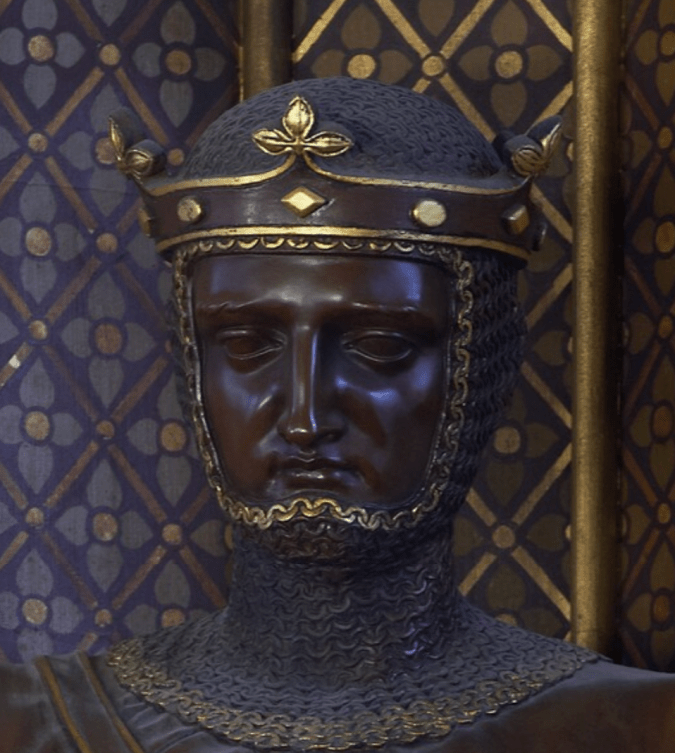
Baron Saher de Quency (d.1219), Earl of Winchester, Appointed to Secure the Observance of the Magna Carta", via ArtUK website
A closeup in the “Parliamentary Art Collection” at Heritage Collections at UK Parliament, Baron Saher de Quency (d.1219), Earl of Winchester, Appointed to Secure the Observance of the Magna Carta.
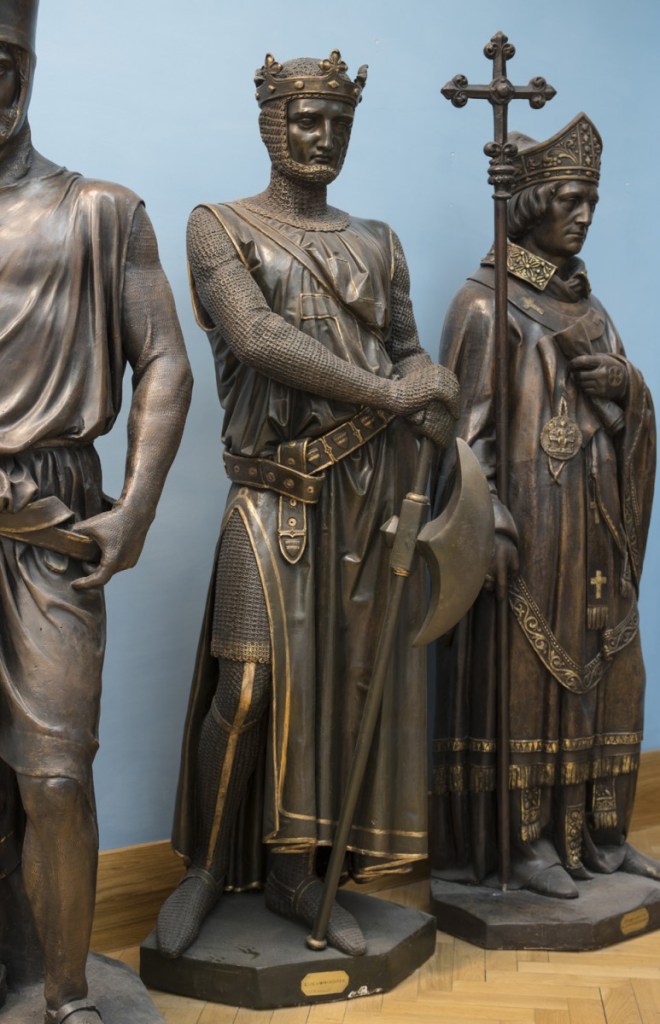
"A life-size figure of Saher de Quincy, Earl of Winchester, with crown and axe. This is a prototype for the equivalent bronze statue in the House of Lords", via ArtUK website.
At ArtUK, “A life-size figure of Saher de Quincy, Earl of Winchester, with crown and axe”.

Magna Carta, a king is not above the law

“Magna Carta … issued in June 1215 … put into writing … that the king was not above the law … placed limits by establishing law as a power in itself” via UK Parliament.

Magna Carta in Latin is ‘great charter’. The Magna Carta has a long history. America and other countries borrowed from the charter when setting up their governments, guaranteeing rights to the people, denying kings and leaders unlimited power.

I was reminded of the Magna Carta while reviewing Ann Mainwaring and Richard Charlton, my 14th great grandparents. 200 years after the Magna Carta, Ann and Richard lived in western England, in Shropshire, near the border of Wales. Richard Charlton’s ancestry is in the book, The Magna charta sureties, 1215; the barons named in the Magna charta, 1215, and some of their descendants who settled in America, 1607-1650. He’s a descendant, number 12 in a line of barons, of Saer de Quincy, 1st Earl of Winchestter, “a leader of the First Barons’ War against King John” and probably my 22nd great grandpa.

I wish I’d known this relationship while studying history in high school.

The Magna Carta was born out of baron rebellions. Land owners rebelled against King John and his protectors. King John was despised, had an awful personality and was a lazy and corrupt King. He taxed the barons and gave them nothing in return so there were uprisings and murder plots, then a standoff, then the Magna Carta was signed but blocked by the pope, more battles followed, support for the king declined until his death in 1216. King John’s Henry at nine years old was made King. The Magna Carta was approved and finally “repeatedly confirmed and reissued and became well-known across England, not just among the barons, but also in the counties”.

Wikipedia links to royal bios and history

The Magna Charta Sureties, 1215: the Barons Named In the Magna Charta, 1215, And Some of Their Descendants Who Settled In America, 1607-1650 book at HathiTrust. 138 pages “considered a foundational and historically important genealogy source”, but published in 1955 cross checking with current research is recommended.

John Smith and Marah Huntley b. 1660

John Smith and Marah Huntley 8th great grandparents on RootsMagic tree.

Marah, or Mary, Huntley was born on December 3, 1660 in Lyme, Connecticut.- a new record shows Marah born in Roxbury, Massachusetts. The date is definite- the place is not. She was the 4th child of John and Jane Huntley. Her dad John Huntley would sail to Barbados, where he traded fish for tobacco and cotton. A record shows he bought a pair of shoes and a shirt for his wife on one trip. He probably bought back gifts for his kids too.

John Smith was born November 20, 1655 in Massachusetts, to Richard and Joanna Quarlls Smith who were both from England, and married in Boston. John and his family moved to Lyme Connecticut soon after John’s birth. In Lyme, on October 26, 1685 John and Marah married. They had at least 10 kids and stayed in the Lyme, New London, Connecticut area.

Before they married, John Smith, his dad and Marah’s dad, both their grandads, and future in laws were part of the Lyme Riot of August 1671. New London and Lyme, Connecticut, towns next to each other, had a history of land disputes. In 1671 men from both towns fought over mowing the minister’s meadows. 30 men from New London wanted to mow, a group of men from Lyme set out to do the same, and the riot started. After a while leaders from both towns met and “drinking a dram together with som(e) seeming friendship, every man departed to his home”. The men were fined, the courts eventually covered the fines.

John Smith died in Lyme, Connecticut on October 11, 1736. Marah Huntley Smith died soon after.

Sources

Samuel Risley b. 1679

Samuel Risley 8th great grandpa on RootsMagic tree.

Samuel Risley was born in 1679 in Hartford, Connecticut, one of 12 children of Richard and Rebecca Adams Risley. Samuel’s grandfathers Richard Risley and Jeremy Adams, born in England in 1615, were in Hartford in the 1630s and were “original proprietor[s] of Hartford”.

Samuel married Rebecca Gaines on August 1, 1704. They had 9 children. In Hartford, Samuel, like his dad, was a fence viewer. Elected in 1703, 1707 and 1712, he  inspected fences and made judgements on property line arguments  for people and grazing livestock.

In 1713 the Risley family moved to Glastonbury, still in Hartford County about 15 south along the Connecticut River. Samuel’s older brother John lived there with his family too.

Samuel died on February 6, 1756 and is buried at Old Eastbury Cemetery in Glastonbury, Connecticut. His gravestone is weathered but still there. HIs gravestone is  intricate with a heart at the bottom and a face at the top and inscribed, “In memory of Mr Samuel Risley who died Febr 6th 1755 in ye 77th Year of his Age”.

Find a grave memorial

In 1752 Samuel wrote his will: “In the name of God Amen this 9th day of May, 1752, I, Samuel Risley of Glastonbury being, of a disposing mind and memory (thro’ God’s Goodness) do make and ordain this to be my last will and Testament as follows: My mind and will is that my just debts and funeral charges be first paid out of my moveable Estate. I give and bequeath to my Beloved Wife Rebecca one hundred and fifty pounds out of my moveable Estate old Tennor [money] and also ye free use and improvement of ye one half of my dwelling house and cellar and three acres of land by said house as long as she shall Remain my widow.” Samuel’s sons and daughters inherited old Tennor [money] and lands. Thomas, the youngest son was in charge of the estate. 

Samuel’s 2nd great grandson Obed Gaines, born in Vermont, was in Iowa by 1854, 8 years after Iowa became a state. Samuel’s 6th great grandson Faber Miller was born there in Iowa, in 1905.

Sources

Samuel Gaines and Rebecca Couch b. 1670

Samuel Gaines and Rebecca Couch, 8th great grandparents on RootsMagic tree

Samuel Gaines was born in 1670 in Hartford, Connecticut. His grandparents came to America from Buckinghamshire, England. Rebecca Couch was born February 16, 1671 in Hartford, Connecticut. Her grandparents were from Buckinghamshire, England too. Samuel and Rebecca were married around 1694 and they lived near Glastonbury, Connecticut. “At the Glastonbury town meeting of 15 December, 1709 he [Samuel Gaines] was chosen surveyor of highways.” 

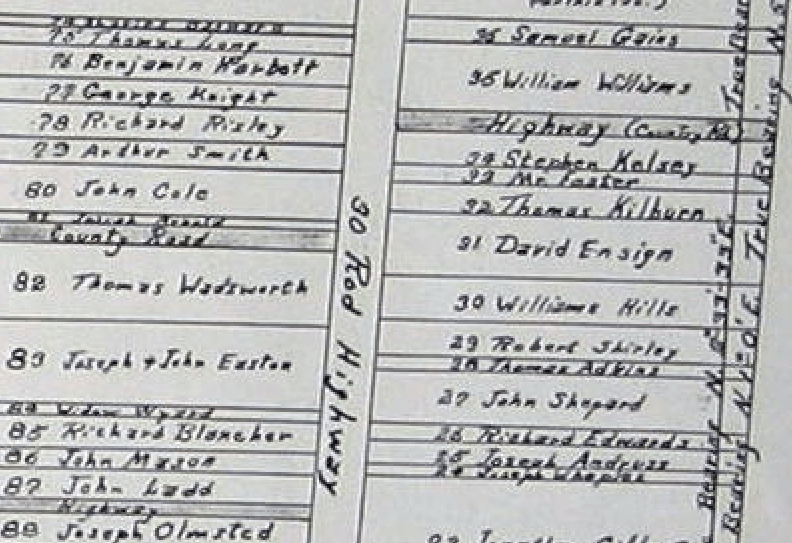
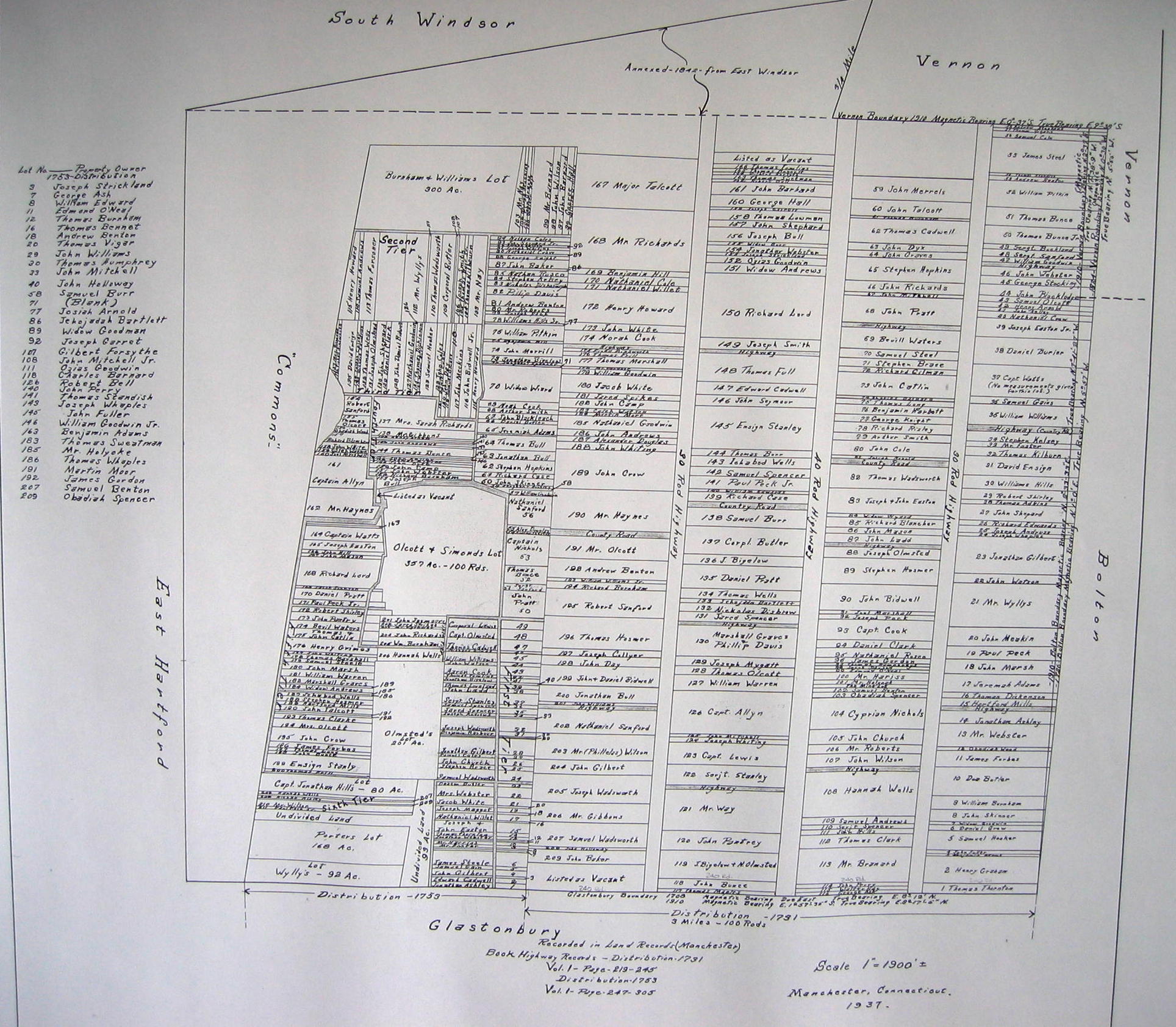
Map of the Five Mile Tract 1731 and 1753

Samuel Gaines inherited, bought and deeded land  in and around Glastonbury from 1705 to 1750. Records of land deeds from 1734-1745, show Samuel’s dad had lands in the Three Mile and Five Mile Tracts of  “1672 when Major John Talcott of Hartford bargained with Chief Joshua the third son of Uncas the Mohegan sachem, for a certain tract of land about five miles square” in present day Manchester, Connecticut.

Samuel and Rebecca’s marriage is probable  and the search still continues for an actual marriage record.  From The New England Historical and Genealogical Register, “this Rebecca Couch had a brother Simon Couch, who lived at Glastonbury, and Rebecca named a son Simon. The age is appropriate for this marriage, and the name Simon is significant”. Rebecca Couch has few records, she probably died in 1750 a few years after her husband.
Samuel died on July 17, 1748.

Samuel and Rebecca’s 2nd great grandson Obed Gaines was in Iowa by 1854. Obed’s granddaughter Mary Ella Gaines married James Miller in Waverly, Iowa, 1878. Mary Ella’s grandson, Faber Miller. was born in Greene, Iowa in 1905.

Sources

Mathias Harter and Anna Shuler b. 1737

Mathias Harter and Anna Shuler 7th great grandparents on RootsMagic tree.

Mathias Harter was born June 5, 1737 in Baden, Germany, the Kingdom of Prussia at that time. HIs parents were Andreas and Anna Zahner Harter. The whole family sailed to America on September 24, 1742 when Mathias was 5 years old. It wasn’t a luxurious journey. Gottlieb Mittelberger, wrote ‘Journey to Pennsylvania 1756’. The book is a “firsthand historic account of the misery and exploitation of German immigrants”. The trip was about 3 months long. There’s a chance Mathias was an indentured servant his first few years in America, he would have worked to pay off his passage.

Anna Mary Shuler was born around 1737 probably in Germany, her parents aren’t known.  Anna and Mathias married September 9, 1759  in New Holland, Lancaster, Pennsylvania. They had 9 children. 

Mathias was in the American Revolution, Second Battalion of Cumberland County Pennsylvania Militia and possibly guarded British prisoners of war. Mathias is on a list of Captain Holderbaum’s company on December 25, 1781 and 1782.  “Roll of the Second Battalion of Cumberland County Militia between the Ages of Eighteen and Forty-five Years taken from the Returns made to me on Oath by the Officers Commanding Companies Given under my hand this 4th Day of July A. D. 1783. JNO. ALEXANDER, Lieut. Cumbd. County” Mathias Harter is number 226 on a list of 445 men.

Tax lists of 1779 show Mathias owned and paid taxes on 140 acres, 2 horses and 2 cows. Mathias, Anna  and children were members of the Evangelical Lutheran Church of Warwick. Pennsylvania.

Pennsylvania, Wills and Probate Records, 1683-1993 at Ancestry

Mathias died in January 1790 in Lebanon, Pennsylvania. Anna died in March 1816. Mathias signed his will October 29, 1789,  ‘sick and weak in body’. He gave Anna “the east room of their home, use of the garden and forage and stable room for her cows and calf”, furniture and “household goods and kitchen furniture as she might need”. Mathias stated at Anna’s death the real estate would be appraised then sons, starting with the oldest could have the land, whoever owned the land would give mortgage to his brothers, if no one wanted the land, it would be sold, the money would be split between sons and daughters. The will was proved on January 26, 1790.

Mathias and Anna’s 3rd great granddaughter Fiana Druckenbrod married William Miller, they were in Iowa by 1876, their daughter Lola Miller was born there in 1880. Lola married another William Miller, their son is Faber Miller, born in 1905.

Sources

Josiah Witter b. 1638

Josiah Witter, 9th great grandpa on RootsMagic tree.

Josiah, sometimes called Joseph, was born on March 15, 1638 in Swampscott, Massachusetts, on the Atlantic Coast, 15 miles  north of Boston. Fictional person Carol Brady, Brady Bunch, and real life person Mary Baker Eddy, founder of the Christian Science religion, are both from Swampscott too. Josiah’s parents William and Annis Churchman Witter of England, were in Massachusetts by 1629,

Josiah’s first wife was Elizabeth Wheeler, they married on December 25, 1661 and had 4 children. They were living in Stonington, New London Connecticut and witnessed the [English immigrant]  founding of Connecticut in 1662. “The Record or Register of the inhabitants names taken this 29th of December 1670 by the selectmen of Stonington according to a town order formerly made the 15th of November 1670 … James Yorke Sr, Josiah Witter, Thomas Bell, James York Jr.”. All are ancestors of Faber Miller, my grandpa. Pequots had been in the area for at least 10,000 years previously.

Elizabeth died around 1671. A Witter family history book suggests she may have died from ‘shock’.  Her death is recorded in a diary of the time and in the book, Wiiter Geneaology. “An item from the curious, old journal of Thomas Minor, one of the early settlers of Stonington, and a neighbor and friend of Josiah Witter, suggests the perils of those far-off Colony days, when savages lurked in the gloom-tangled forests, and it was dangerous to stray far from one’s home save as one of a party well armed.  ‘1671 The Seventh moneth is September and hath 30 days . . . Tuesday the .10 good-wife witer was Lost.’   Whether shock resulting from this incident hastened the death of Elizabeth (Wheeler) Witter , we do not know , but she died on August 5 , 1672 , and was buried two days later . Thomas Minor writes in his diary : ” 1672 The sixth moneth is Agust and hath . 31 . days . . . . the 7th . day wensday Elizabeth Witter was buried”.

Josiah’s 2nd wife was Sarah Crandall,  they had 4 children. The Witter and Crandall families were connected through marriages from the time they came to America in the 1630s. Josiah died around 1690. His will was written on November 24, 1685 the date recorded the Salem Massachusetts court, the paper will is long gone. Josiah may be buried at Avery Cemetery in Preston, New London,  Connecticut, about 2 miles north of the FoxWoods Casino, owned and operated by the Mashantucket Pequot Tribal Nation.

Sources

John Witter b. 1677

John Witter 8th great grandpa on RootsMagic tree.

John Witter was born on March 11, 1677 in New London, Connecticut. His grandparents arrived from England in the 1630s. His parents Sarah Crandall and Josiah Witter shared a history when on July 21, 1651 “John Clarke, John Crandall, and Obadiah Holmes, came from Newport, and went to the house of William Witter, at Swampscot [Massachusetts], where Mr. Clark preached, administered the sacrament, and rebaptized Mr. Witter. This being reported to the authorities, two constables went down to Swampscot to apprehend them as disturbers of the peace.” It was illegal to hold Baptist services, in that place and time. The 3 preachers were put in a Boston prison and fined.

John Witter married Sarah Tefft in 1703 in Rhode Island, they settled in Westerly, also Misquamicutt and Hopkinton, where they were both members of the First Sabbatarian Church, later Seventh-day Baptists. Hopkinton was a part of Westerly where John was a land owner. On February 28, 1710 he received a grant of 203 acres, on January 24, 1715 he mortgaged 101 acres and on December 22, 1743 he deeded 92 acres to his “Son John Witter Junr.” John was a widow in 1720, he married a 2nd wife Mary.

John died in August 1757 in Westerly, Rhode Island and is probably buried with both his wives at Witter Cemetery, also called First Hopkinton Cemetery near where the original Sabbatarian Church Cemetery stood.

Sources
History of Lynn, Essex County, Massachusetts at HathiTrust
https://hdl.handle.net/2027/njp.32101062078561?urlappend=%3Bseq=250
Witter genealogy; descendants of William Witter at HathiTrust
https://hdl.handle.net/2027/mdp.39015025957898?urlappend=%3Bseq=32
A history of the Baptists in New England at Archive.org
https://archive.org/details/ahistorybaptist00socigoog/page/n41/mode/1up
Rhode Island Historic Cemetery http://rihistoriccemeteries.org/newsearchcemeterydetail.aspx?ceme_no=HP022
Find a grave memorial 136297937