Hannah Smith b. 1612

Hannah Smith 9th great grandma on RootsMagic tree.

Hannah was baptized in Leicester, England on September 6, 1612. She probably sailed to America with her parents and then definitely married Edward Mellows by 1636. Then lived in Charlestown, Massachusetts. Hannah was a widow in 1650 and in 1651 she married Joseph Hill, they had children and lived in Boston and Malden, Massachusetts. In May of 1653 Peter Bulkeley, brother of Martha (Hannah’s mother in law from first marriage) helped Hannah with the estate of her Mellows children.
“[345.] Mr Joseph Hills, with the consent of Hanna, his wife, and Mr Peter Buckley [*345.]
Buckley, theire vnkell, offering a petition for the confirmation of the sale of a howse and certayne lands, sould by his wife in the time of her widdowhood, hath his request graunted ; as also power is hereby giuen and granted to the petitioner to make sale of such land as yet remaynes vnsould, by the consent and advice of Mr Buckley, pvided satisfaction be made to the children of Mr Mellowes according to what the land shalbe sould for about what it is prised in the inventory.”

Hannah was a widow again in April 1674 then she died a few months later on July 11 1674. “Deaths: Joseph Hills, Jr. April 19, 1674. Hannah wife of Joseph Hills July 11, 1674”

Hannah’s marriages connect her to both sides of my family tree. Hannah’s first husband was Edward Mellows, his mother Martha Bulkeley 11th great aunt. Hannah’s 2nd husband was Joseph Hills, their son Samuel Hill was 6th great grandfather of Elizabeth Speedy who married Stanley Roose.

Smith, Dean C, and Melinde L. Sanborn. The Ancestry of Eva Belle Kempton, 1878-1908. Boston: New England Historic Genealogical Society, 1996.

Jacobus, Donald Lines, 1887-1970. The Bulkeley Genealogy: Rev. Peter Bulkeley, New Haven, Conn: Tuttle, 1933.

Massachusetts. General Court. Records of the Governor And Company of the Massachusetts Bay In New England: Boston: W. White, printer to the commonwealth, 1853-54. http://tinyurl.com/y5rjyf86

Hannah and Joesph’s death dates. The Society. The New England Historical and Genealogical Register, Volume 10. The Society, Boston 1856

Annis Austin b. 1596

Annis Austin 10th great grandma on RootsMagic tree

Annis was born in Exeter, England on February 1, 1596. In 1614 she married Edmund Littlefield, they were parents of 8 kids. Before 1638 Edmund and an older son sailed for America. In 1638 Annis went to America. She sailed on the Bevis with her younger kids and a couple servants. Annis’s brother Richard Austin with his family and a servant were on this same ship which landed in Boston May of 1638. (Annis’s brother Richard is the 3rd great grandfather of Stephen F. Austin, who founded Texas). Annis Edmund and family stayed in Boston for a short time then moved on to Wells, Maine where Edmund built the first sawmill and gristmill near Webhannet Falls. Annis with her family farmed and cleared the way for other English settlers. “With the aid of his large family, he (Edmund) prepared the way for the habitation of man”.

Annis was a widow in 1661 and wrote her will on December 12, 1677. She mentions each of her children and leaves land, wools, linens and a bed to daughter Hannah and husband Peter Cloyes- 9th great grandparents.

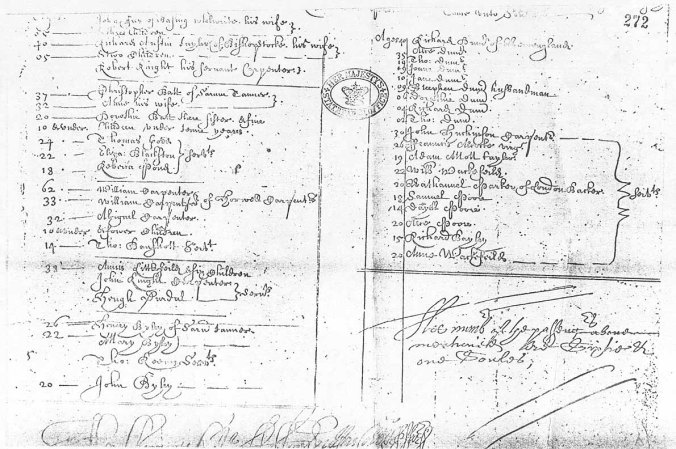
Austin, Annis on the Bevis closeup

Annis and children sailed on the Bevis 1638

Bevis_Passengers_1638

List of passengers 1638 on the Bevis

The history of Wells and Kennebunk from the earliest settlement page 77 

Richard Austin on Wikipedia
https://en.wikipedia.org/wiki/Richard_Austin_(colonist)

The ship Bevis on Wikipedia with image of handwritten list
https://en.wikipedia.org/wiki/Bevis_(ship)

The Wells, Maine PD has a post on their Facebook page with a photo of the Littlefield marker: The Bridge of Flowers at Webhannet Falls.

Widow Walker b. 1600

Widow Walker 10th great grandmother on RootsMagic tree.

Widow Walker’s first name is unknown, her last name was probably Brown. She was born in England around 1600, married, then was widowed by 1635 when her two older children Sarah and James came to America with their uncle the widow’s brother, his name may have been John Brown. The widow and younger son Philip came to America about 1640. Widow Walker is on land records in 1643, 1644 and 1646 then she disappears with no more records. By 1658, son Philip is on land records. So her estimated death is in 1658 at about age 58. There are theories on her Brown family ancestors and her husband’s Walker family ancestors, but not much is proven, except her land.

Land Widow Walker and Zachariah Rhodes 1644 screenshot

The history of Rehoboth, page 25

In Vital Records of Rehoboth on page 911: “At a Town Meeting, the 31st day of the 4th month 1644, lots were drawn for a division of the woodland, between the plain and the town. Shares were drawn to the number of 58 as follows”: Widow Walker is the only female on the list of 58 which included The Schoolmaster, The Governor and The Pastor. Thomas Bliss 8th great grandpa of Elizabeth Speedy is also on the list.

Sources at HathiTrust
The history of Rehoboth, Bristol County, Massachusetts, page 25 Widow Walker and Zachariah Rhodes of Seakonk alias Rehoboth.

Vital record of Rehoboth, 1642-1896, page 911, Widow Walker No. 52

The story of my ancestors In America, page 8 Widow Walker settles in Seekonk, Rehoboth, land grants


John Drake b. 1585

John Drake 12th great grandfather on RootsMagic tree.

John Drake was born in England about 1585. Past research on John Drake connected him to King Henry the 8th, Shakespeare and Sir Francis Drake, but it’s all been proven very unlikely. So John was born in England where he married Elizabeth and they had 5 children. In 1630 the Drakes arrived in America, sailing on the Mary and John. The passengers on this ship are considered the founders of Windsor, Connecticut. They lived in Dorchester first then the whole group moved to Windsor, Connecticut. John was a woodworker, a farmer and was active in town services. He was on several juries and on December 1, 1645 one of the constables in charge of gathering up knapsacks filled with powder and bullets, delivering those knapsacks to a Mr Talcott and keeping a written record of the ‘particulars so delivered’.

John died in an accident. Driving a cart full of corn ‘Something Scard the Cattle and they Set a running, and he Labouring to Stop them, by taking hold on the mare, was thrown’.

He wrote his will in 1659 and mentions each of his children.

John’s burial is unknown but his name is on the Founders of Windsor Monument at Palisado Cemetery in Windsor, Connecticut. The monument reads, “To the founders of Windsor and the First Congregational Church in Connecticut which came to America in the Mary and John with its pastor John Warham May 30, 1630, Settled in Dorchester, Massachusetts and migrated to Windsor in May and October 1635.”Snapshot for the Windsor Historical Society. 3 ancestors of Faber Miller are on the monument: John Drake, Thomas Dewey and Henry Wolcott

Sources

John Whipple b. 1617

John Whipple 10th great grandfather on RootsMagic tree.

John Whipple was born in Essex, England in 1617. John age 14 or 15 arrived in Dorchester, now part of Boston, late summer of 1632. A servant of Israel Stoughton, John would have agreed to work 4-5 years in exchange for travel to America. His arrangement with Stoughton didn’t start out so well. October of 1632 John and another servant, Alex, were brought to court and ordered to pay Stoughton a certain sum each, for the powder and shot they’d wasted. In 1640 John was a Freeman, he’d worked off his debt. In 1641 he married Sarah, her last name is not known.

By 1658 he lived in Providence and stayed through King Philipps War, one of 27. These 27 who ’ staid’ were rewarded with a servant, an American Indian, captured in the war. Depending on their age the captured servants worked a certain time then had their freedom again. The Puritans believed this was an OK arrangement compared to other colonies that killed Indians captured in King Philips War. Through the years John was a carpenter, farmer, tavern keeper and chosen for lots of town services: selectman, treasurer, surveyor, etc. He was also on several committees, even in colonial America there were committees and meetings.

John Whipple's will 1682

John Whipple’s will 1682

John wrote his will May 8, 1682 with all his children named and son Joseph as executor. “Be it known to all persons to whom this may come, that I, John Whipple of the town of Providence, in the colony of Rhode Island, and Providence Plantations, in New England (Sen.) being in good measure of health, and in perfect memory, upon consideration of mortality, not knowing the day of my death, and having many children, and to prevent difference that otherwise may hereafter arise among them concerning my worldly estate, do see cause to make my will and do hereby dispose of all my estate in this world and do make my last Will and Testament.”

John died May 16 and is buried in Providence at North Burial Ground. He and Sarah have matching headstones, dated from 1740, not the 1680s.


Records of the Governor and company of the Massachusetts Bay, Volume 1 page 100 John Whipple and another in court.

The early records of the town of Providence, Volume 8 page 12 27 who ‘staid’ And Volume 15, page 161 details 

Rhode Island historic cemetery database
http://rihistoriccemeteries.org/newgravedetails.aspx?ID=215026

The early records of the town of Providence Volume 6 page 124-135 John Whipple’s will, inventory, probate.

Thomas Barnes b. 1602

Thomas Barnes 11th great grandfather on RootsMagic tree

Thomas was born about 1602 in England and was living in Hingham, Massachusetts by 1637 when he and his (probable) brother Peter were on a handwritten list, First Settlers, of Hingham. About 1643 Thomas married Anna her last name is unknown. Thomas was a weaver and farmer. He was a freeman in 1645.

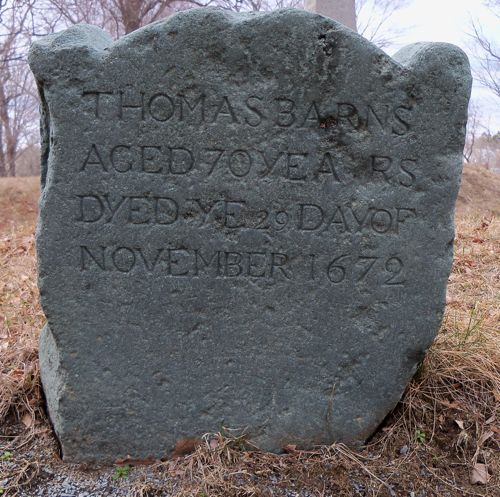
Barnes, Thomas headstone

Thomas Barnes d. 1672

His will was written April 29, 1671. He named his wife and children and his inventory included books, blankets, a cedar chest, yards of cloth, cotton and woolen yarn, 5 painted earthen ware dishes, weaving and farming supplies, livestock, bushels of produce, lots of land.

Thomas died in 1672 and is buried in Hingham Cemetery. The cemetery was founded in 1672 Thomas’s headstone was the first, this is noted on FindAGrave. The headstone is original but doesn’t mark his burial place. It was placed with others in a circle around the Founders Monument. The cemetery is right behind Old Ship Church, the only remaining 17th-century Puritan meeting house in America.


The ancestry of Emily Jane Angell, 1844-1910 page 195 Barnes section

At Ancestry. Massachusetts, Town and Vital Records, 1620-1988 Hingham Records of First Settlers image 2 of 81 Thomas and Peter Barnes 1637 Thomas d. Nov.29 1672

At HathiTrust.

Find a Grave memorial 51474179. Oldest original headstone in the cemetery. Headstone photos “Added by Hammer”

Old Ship Church on Wikipedia

John Connable b. 1650

John Connable 8th great grandfather on RootsMagic tree.

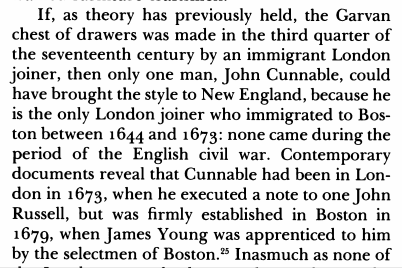
John Connable was born in England about 1650 or so. An Ancestry source “US Craftperson Files 1600-1995” shows his occupation as carpenter, joiner, artisan. This craftsman source leads to a 30 page paper “The Seventeenth Century Case Furniture of Essex County, Massachusetts, and Its Makers”. Author Benno Forman researched ‘the origins of the joined chest of drawers’ in early America. The conclusion, “only one man John Cunnable could have brought this style to Boston’. The author includes the ‘Garvan’ chest at Yale’s Art Gallery as evidence.

Connable chest of drawers

The Garvan chest at Yale

Connable, John joiner

Then only one man, John Connable, could have brought the style to New England.

Connable, John signature

John Cunabell, joiner of London

Besides his skills in woodworking John married 3 times, had a large family, fought in King Philips War, took the Oath of Allegiance, was a freeman and for several years a ’tithing man’ responsible for arresting travelers on Sunday – travel was forbidden on the Sabbath.

His death is recorded in a diary of the time, “10. On ye 10 in ye morning about 5 old Mr. Connabell, ye joiner, dyed and buryed on ye 13 day aged 74 years 3 months 15 days”.

Online
The Garvan chest at Yale Art Gallery

The article Seventeenth Century Case Furniture
image 14 of 31
Catalog page http://www.jstor.org/stable/1180998?origin=JSTOR-pdf

“The drawers of the Garvan chest and the SPNEA chest (fig. to), in contrast to those in all the joined furniture known to have been made elsewhere in Massachusetts before 1675, are held together with dovetails, as opposed to the usual, rural Anglo-American technique of nailing flushcut drawer sides into rabbets planed into the sides of the drawer fronts”

At Archive.org
Volume 15 page 201 Diary of Jeremiah Bumstead of Boston 1722-1727 in The New England historical and genealogical register 1861 Volume 15.

At Ancestry
U.S., Craftperson Files, 1600-1995

At HathiTrust
Volume 1 page 9 several pages. Genealogical memoir of the Cunnabell, Conable or Connable family.

Benedict Arnold b. 1615

Benedict Arnold 11th great uncle on RootsMagic tree

This Benedict Arnold was born in 1615 in Ilchester, England and was 19 when he sailed with his family to Massachusetts Bay. (This is Benedict Arnold No. 1, his 2nd great grandson was Benedict No. 5 of the American then British army). By 1636 the Arnolds were in Providence. In 1640 Benedict married Damaris Westcott, her family probably sailed to America on the same ship with the Arnold family. Benedict was President then Governor of Rhode Island for 11 years and with Roger Williams a trusted interpreter of the American Indian language. While looking for information on Christiana Peake Arnold, Benedict’s mom, I found a book, ‘The burying place of Governor Arnold’ by Alice Brayton about the establishment, destruction and restoration of the Governor’s burial grounds. Images are from this book. It’s in the public domain, an ebook at HathiTrust.

Alice Brayton of Newport, “In the spring of 1946 as I was walking down Pelham Street in Newport, Rhode Island, I saw a dozen people and a red flag in front of a dilapidated late nineteenth century cottage. It was an auction. The house was for sale. “How about the land behind the house Is it included?” “Yes, the house and the land behind the house.” “But the land behind the house, they tell me, is the burying place of Governor Arnold and his family. You can’t auction off a burying ground. It isn’t decent.” (It isn’t even legal in Rhode Island, as I found out later.) However, I bid in the house and the land behind the house. In this casual fashion I acquired Governor Arnold’s graveyard”.

Benedict Arnold wrote in 1675, “I order that my kindred relations may as they die be buried at convenient distance about my grave.” For a time Arnold and his family were buried in this cemetery then it was kind of forgotten. In 1901 a report was presented on the condition of the site, with nothing done and when Alice Brayton came along in the 1940s the site was “desolation and tin cans”.

Arnold, Benedict Newport home

Newport the seat of the Honorable Benedict Arnold

The book has b&w photos from the 1940s and stories of the family. Rhode Island Historical Cemeteries has full color photos. Originally Benedict and Damaris’s headstones had large plaques or stones, those are long gone. Photo of the cemetery today at Rhode Island Historical Cemeteries.


Brayton, Alice. The Burying Place of Governor Arnold, Newport, R.I.: Privately printed, 1960.

Page 19 Rhode Island. Commissioner to inquire into the condition of the Benedict Arnold burial place, and James N. (James Newell) Arnold.Report of J. N. Arnold, Commissioner to Inquire Into the Present Condition of the Governor Benedict Arnold Burial Place, And the Title Thereto. Providence: E. L. Freeman & Sons, 1901

Christiana Peake b. 1584

Christiana Peake 11th great grandmother on RootsMagic tree

Christiana Peake was baptized on Feb 15 1584 in Somerset, England. Her dad was Thomas, her mother and siblings are unknown. Christiana lived in Elizabethan England with the pencil invented, the new idea that the Earth rotated around the Sun, Shakespeare’s plays, the Spanish Armada, religious turmoil and major migrations to New England.

By age 25 she married William Arnold also of Somerset. Their church was St Mary Major in Ilchester where husband William was a church warden. They had 4 children that lived to adulthood and when William’s sister Joanne and her husband William Hopkins died, Christiana and William took in the Hopkins kids and they all sailed to America in 1635. The only record of their trip is son Benedict’s note,”Memorandom my father and his family Sett Sayle from Dartmouth in Old England, the first of May, friday. Arrived In New England June 24 Ano 1635″. Christiana arrived in Massachusetts when she was 48. Her family moved to Rhode Island and were on that list: A family census of Moshassuck and Pawtuxet, for September 1, 1636. The Arnolds moved to Pawtuxet, now Cranston where they were probably the area’s biggest land owners. Both Christiana and her husband lived to their 70s, their burial place is unknown. They probably died in Kent Rhode Island going there to live with their son Stephen to escape King Philips War in Pawtuxet. Christiana lived to see her grandchildren and her children’s successes including son Benedict becoming a governor of Rhode Island.

Benedict’s note. The New England historical and genealogical register 1879 Volume 33 page 427 to 432 (England origins of this article are now considered false. The American information is good.)

Arnolds leaving King Philips War, William Hopkins giving his recollection 16 October 1678 in The early records of the town of Providence, volume 15 page 182.

The history of the state of Rhode Island and Providence, Volume 1 page 158 Providence It’s Beginnings. September 1, 1636 census or list of residents.

Ludwig Fryburger and Anna Beatty b. 1743

Ludwig Fryburger 6th great grandfather on RootsMagic tree

Ludwig Fryburger was born in 1743 in Baden, Germany. He arrived in America on ‘The Hero’ October 27, 1764 and took an oath to the ‘Province and State of Pennsylvania’. Around 1766 Ludwig married Anna Maria Beattty. Ludwig probably fought in the American Revolution, shown by a marker at his headstone, no records found yet to prove this. In 1786 he paid taxes in Northumberland, Pennsylvania on: 50 acres of land, 1 horse, 2 cows, valued at  $13, state tax was 0 pounds 2 shillings 2 pence. In 1790 he is on the country’s first federal census living in Northumberland. PA with wife Anna, 4 sons and 2 daughters. Ludwig and family moved to Goshen, Ohio around 1800. Ludwig died there in 1802 and is buried in Myers Cemetery, Goshen, Ohio. His headstone has him as the first burial in this cemetery. He shares a headstone with his wife Anna. There are several Fryburgers buried in this cemetery.

Sources

  • Names of foreigners who took the oath at HathiTrust. Page 466 List of foreigners imported in the ship Hero Capt. Ralph Forster from Rotterdam last from Cowes. Qualified Oct 27, 1764 [30 – Vol XVII random?], Ludwig Frieburger, page 466 right column 4th name. 
  • Pennsylvania, Tax and Exoneration, 1768-1801 at Ancestry. 1786 Northumberland Penn image 83 of 111 Penns. on Ancestry.
  • Find a Grave memorial 20297018
  • 1790 census at FamilySearch.org. FHL 0568149 Digital Folder 005157141 Image 00298 (43 of 53). Ludwick Freyberger, Northumberland, Pennsylvania, United States; citing p. 80, NARA microfilm publication M637, roll 9