Hope Angell 1780 recruiting for the Revolution

July 1780 a Revolution in the making:
Be it therefore enacted by this General Assembly, that the persons here-after named be, empowered and directed, to form all male persons sixteen years and upwards, residing within their respective towns (deserters, Indians, mulattoes and negroes excepted), into classes; and each of the said classes is directed to furnish one able-bodied, effective man, by the 12th day of July instant.

And it is further enacted, that the following persons be appointed in the respective towns, for the purpose, afore-said, to wit: Names of Person appointed by the General Assembly for the several Towns to receive Recruits. North Providence Messrs. Eleazer Jenckes, Eleazer Whipple, Hope Angell, Thomas Olney and Christopher Whipple.

In 1780 Hope Angell 7th great uncle was 38, his older brother Israel  6th great grandfather was 40; and in the midst of the American Revolution which lasted, very generally, from 1774-1782. The above is from Records of the colony of Rhode Island and Providence Plantations, in New England : Printed by order of the General assembly at HathiTrust, specifically volume 9 of 10, pages 126-128.

At a previous session the second Monday in June 1780 (page 101), the Assembly voted to ‘raise’ 610 able bodied men for the state’s Continental battalions. By the first Monday in July 1780 assembly meeting, Rhode Island was still short in men, so groups were appointed, in each town to classify and enlist some men as soldiers.

This one assembly gathering goes on for pages, some items included:

  • Captain Stephen Olney, paymaster of Colonel Israel Angell’s battalion taking pairs of overalls and shirts to  men (page 134).
  • Monsieur Lewis Ethis de Corny, of the French Army unable to find a suitable house in Providence (page 120).
  • consequences for able men not doing their duty, money for men doing their duty.

The assembly ends (page 149) with: God save the United States of America, and letters written between William Greene, Governor of Rhode Island and General Washington.

Source

Elizabeth Harter b. 1795

Elizabeth Harter 5th great grandmother on RootsMagic tree

Elizabeth was born in 1795 in Beaver, Pennsylvania near Pittsburgh. At age 9 or so Elizabeth and her family set out for Ohio, ‘Early in the spring of 1806 the family of George Harter started from Beaver in a six-horse wagon for their new home in Ohio. A daughter, then in her ninth year, later Mrs. Jehu Grubb, had in after years a very distinct recollection of the journey out; of seeing the men at work digging the race for Slusser’s mill, as they crossed Nimishillen: of her great disappointment at the size of Canton, expecting to see it as large as Pittsburg-, when it contained only three cabins, all told.” Page 43 Old Landmarks of Canton and Stark Ohio at HathiTrust.

Part of Elizabeth’s childhood in Canton was working the family farm. At 15 she’s sent to the town mill with bushels of wheat. On Elizabeth’s horse is the lighter sack, also she’s leading a second horse with the heavier 3 pound sack. It’s a long day riding to the mill, then waiting at the mill. Elizabeth starts home closer to dark than she had hoped. Following the trail through the woods is more difficult without sunlight. She rides on with her milled wheat (flour- but not like 2016 flour) and two horses. At one point she strays from the trail and a tree bough sweeps the bag of flour off the second horse.

“Here was a new difficulty, and she was about at her wits’ ends : but the girls of that time did not readily yield to trifles, and Elizabeth dismounted and used her best endeavors to put the sack back to its place; she did succeed in getting it upon her shoulder, but her strength was not great enough to throw it over the horse ; she worried herself with it, however, a long time, and was about giving up in despair, with the thought of going back to Canton until morning, as she had yet several miles home, when an old settler, Frederick Rodacker, happened to come along, and threw the sack upon the horse.”

The old Mr. Rodacker offers Elizabeth a place to stay till morning, she accepts. Back home her mom Elizabeth Bowman Bair is worried and “she blew a horn for more than half the night, so that her daughter might discern the way to the house”.

Elizabeth Harter was married to Abraham Bair and a mom at 18. After marrying Abraham she wasn’t so much a housewife. She didn’t stay in the house but was outside with her husband clearing land, rolling logs and burning brush. She may have had 10 children total with Abraham and her 2nd husband Jehu Grubb. Elizabeth’s War of 1812 pension application and her record keeping were majorly responsible for 2nd husband Jehu Grubb being recognized as a son in the Grubb Family dynasty, Curtis Grubb was Jehu’s father. Jehu’s story is worth reading, on Wikipedia.

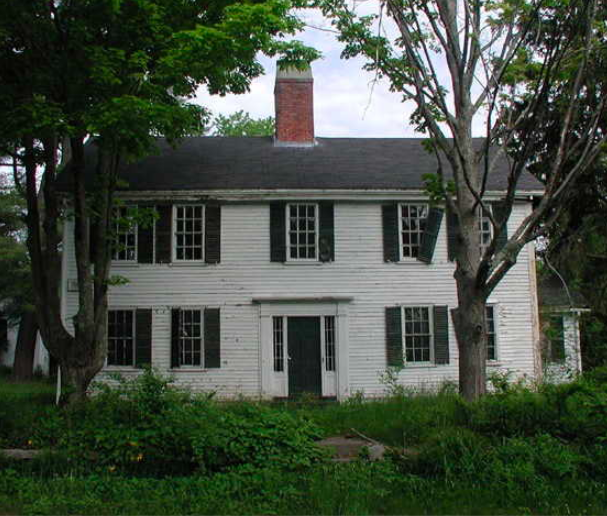
bair-house-jacob-hFirst child Jacob built this house (at Wikipedia, photo by Sanfranman59). It is part of the National Register of Historic Places listings in Stark County, Ohio. The home was probably built in 1869 in Elizabeth’s 73rd year. Jacob inherited land from his stepfather Jehu Grubb’s estate and built this house on that land.
Sources

Job Drake b. 1622 and Mary Wolcott b. 1622

Job Drake, 11th great grandfather married Mary Wolcott. Job was b. in Devon, England 1622/3. Mary was born in Tolland, England 1622/3. They both arrived at Boston in 1630 on the “Mary and John”. Job was 7, not sure who he arrived with. Mary was 8 and came with her family. [Source listed on Ancestry.com for these facts: SPEAR, BURTON W. “Passengers Aboard the Mary & John.” In The Second Boat (Pentref Press, Machias, ME), vol. 1:2 (Aug. 1980), pp. 4-8.]

It’s a coincidence they arrived in America on the same ship. Mary’s family ends up in Connecticut by 1636. Job’s family location is not known. On June 25, 1646 they marry, probably in Windsor, Connecticut. I wonder if they ever knew they arrived together in America- did people of those times talk about things like that in getting to know each other?

An even bigger coincidence is that this husband and wife die on the exact same day: September 16, 1689. Their double headstone is at FindAGrave in the Palisado Cemetery,
Windsor, Connecticut: Mrs. Marih Drake, Mr Job Drake.

Sources

U.S. and Canada, Passenger and Immigration Lists Index, 1500s-1900s Place: Boston, Massachusetts; Year: 1630; Page Number: 8. Listed as source for this $ source: “Passengers Aboard the Mary & John.”  by Spear, Burton, -at Ancestry $ 

U.S., Find A Grave Index, 1600s-Current, free via Ancestry. The Drakes

Joshua Tefft b. 1650 treason, maybe

Joshua Tefft (10th great uncle) was tried for treason, “The fact that he was known not to have attended church, a considerable offense to the strict Puritan sensibility of the United Colonials, was also used against him at his trial.” The United Colonials were loosely Massachusetts, Plymouth and Connecticut. These Colonials made a plan to take Rhode Island and the Narraganset tribe’s land as their own. Somehow this all gets mixed up in King Philip’s War and Joshua, living on his farm in Rhode Island with his son- his wife dies 2 days after giving birth- attempts to defend his farm, is captured by the fighting Narraganset tribe and held as a slave. That’s one story.

Or Joshua, living peacefully with his family was somehow wronged and left the family and colony to take up with the Indians whether out of spite or pride. He rose in rank to become an advisor to Metacomet, King Philip.

Or, according to some United Colonial Soldiers, Joshua Tefft’s deceased wife was of the Wamponoag tribe and Joshua joined forces with the Narragansets and Wamponoags and fired 20 shots against the colonists.

Definitely Joshua was taken to court. Roger Williams recorded Joshua’s court statements, most court records have been permanently lost. Joshua was definitely convicted of treason, hanged, drawn and quartered. Facts are scarce and it appears the verdict then January 1676 and today is still somewhat undecided. Joshua was the only person executed for treason in New England history. John Tefft (1oth great grandfather) is described as ‘losing his head’ at his son’s execution. John was either beheaded, overwhelmed with grief or could not recover Joshua’s actual head which was supposedly mounted on a stake or used ‘for sport’.

Joshua’s son Peter was about 6 years old when his uncle Samuel (9th great grandfather ) and Jireh Bull were appointed guardians to oversee Peter and his inheritance. Peter lived and grew up with Samuel and Elizabeth Jenckes Tefft. Joshua’s orphan son marries Sarah or Mary Witter they have children and hopefully a happy life.

Sources

Rhode Island Renegade: The Enigma of Joshua Tefft by Calloway, Colin in Rhode Island History. Vol. 43 (November 1984) PDF here pages 136 – 145 image 22 of 38. (This source provides a lot more sources including) 

The Narragansett Historical Register: a Magazine edited by Arnold, James N, Volume 3 pages 164 – 169 at HathiTrust.


John Adams letter 1800 only honest and wise in this house

John Adams is no longer connected through Jeremy Adams and family but I’m keeping this as it compares a place and a time to our modern times.

This is what 2nd President John Adams (4th cousin 9x removed) wrote from the White House about 216 years ago in a letter to his wife Abigail:

screenshot.png

Before I end my letter, I pray Heaven to bestow the best of Blessings on this House and all that shall hereafter inhabit it. May none but honest and wise Men ever rule under this roof.

Letter from John Adams to Abigail Adams, 2 November 1800 [electronic edition]. Adams Family Papers: An Electronic Archive. Massachusetts Historical Society. http://www.masshist.org/digitaladams/

Adams wrote this in November of 1800, just before the election, won by Thomas Jefferson. Today in America October 2016 we’re about 1 month away from electing the 45th President. My ancestors would be horrified.

Israel Smith b. 1689 and Elizabeth Arnold b. 1684

The wills of Israel Smith and his wife Elizabeth Arnold Smith Hawkins (8th great grandparents) contain inventories along with written wishes. Israel was a yeoman or landowner. He died at 37 in 1726. His inventory included: books, livestock, tools, seeds, a gun, a feather bed, blankets, linens, clothing, kitchenware, including pewter platters, 10 pounds of woolen yarns, thirty eight pounds of flax, spinning wools, furniture, tobacco and candlesticks.

Elizabeth outlived 2 husbands, she died at 74 in 1758. She left specific items for her daughters and granddaughters. Naomi Smith Angell inherited a Square Table and five pounds old Tenor. Daughter Elizabeth received the Long Cloke, Deborah got the Kettle and divided the featherbed with Ruth. Elizabeth’s will directed that her best buttons were for her granddaughters, “My will is that my Grand Daughter Elisabeth Hopkins have my large Silver Sleeve Buttons. Item, I give my Grand Daughter Martha Smith my Small Silver Sleeve Buttons, my looking Glass.”

Elizabeth’s will was transcribed at Rhode Island USGenweb, part of RootsWeb, a goldmine of early online family history collaboration begun in 1996, a free collaborative site, then purchased by Ance$try with a promise of preservation. Some of RootsWeb exists, a lot is erased.

Sources

  • Providence, Rhode Island, Wills (1678-1916) and Indexes, Volume 3-4, 1726-1754, page 121, 122, 123, 124 at Ancestry
  • Broken link. Rhode Island USGenWeb Project, Rhode Island Reading room Wills page 4 public document transcribed at: http://www.rootsweb.ancestry.com/~rigenweb/wills4.html


Sarah Towne b. 1658

Unrelated (2nd wife of 9th great grandfather) but what a story, Sarah Towne on RootsMagic tree.

Sarah Towne Bridges Cloyes, had 2 sisters Rebecca and Mary, who were tried and  jailed during the Salem witch trials. After defending her sister Rebecca Nurse and being so frustrated by the implausibility or stupidity of the situation, she walked out of the church and purposefully slammed the door– most likely never, ever done before or since? After slamming the church door Sarah is also accused of being a witch.

All three sisters: Sarah Towne Cloyes, Rebecca Towne Nurse and Mary Towne Easty are put in jail. Rebecca, 71 and Mary, 58 were both hanged in 1692.  Ann Putnam, age 13, had accused 62 women of witchcraft. In 1706 she publicly apologized for her lies, her actions and specifically the harm she caused for the Towne sisters and their families. The Towne family forgave Ann Putnam.

Sarah’s husband Peter either helped Sarah escape from jail or he paid for Sarah’s release, details are sketchy. Sarah and Peter went southwest to Danforth’s Plantation, now Framingham. They probably knew this was a safe place and later on received land from Deputy Governor Thomas Danforth who released 800 acres to families fleeing Salem. There is so much history to the Salem witch hysteria. A person could spend years reading the surviving primary documents and research on those involved. 

Author Nathaniel Hawthorne’s book Young Goodman Brown refers to Sarah Cloyes. Word is the author changed the spelling of his name so he wouldn’t be associated with John Hathorne, his great great grandfather and the only judge not to apologize or question his role in the horror of the Salem witch hysteria. screenshot.png

The home of Sarah and Peter Cloyes built ca. 1690 is still standing and currently going through majors restoration. The house is at 657 Salem End Road, Framingham, MA; visit the restoration website*update* The restoration site is still there but as of Feb 2019 this house is redone and on the market for $900,000. *update* On the outside the house looks about the same, inside it looks like any other newer home, bright and shiny, but maybe lacking character.

At Wikipedia Salem witch trials:

The episode is one of Colonial America’s most notorious cases of mass hysteria.

It has been used in political rhetoric and popular literature as a vivid cautionary tale about the dangers of isolationism, religious extremism, false accusations, and lapses in due process.

Elizabeth Tilley b. 1607

Jabez Howland house

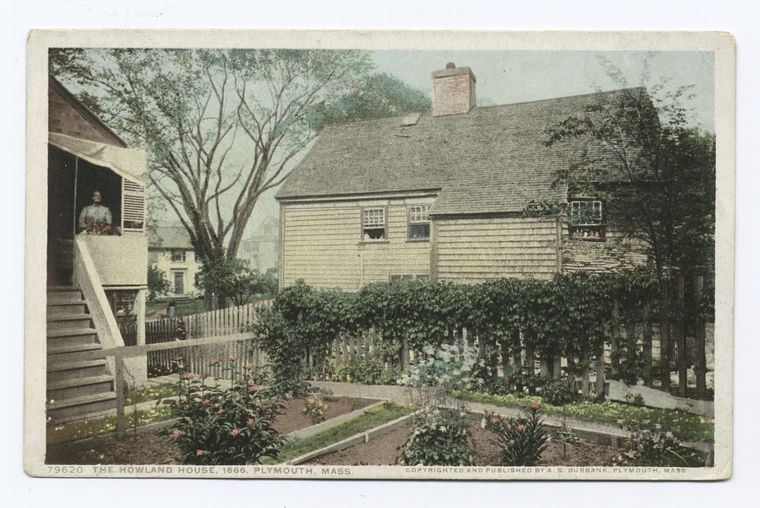
Postcard. The Howland House, 1666, Plymouth, Mass.

I’ve added Mayflower passengers to my family tree. Elizabeth Tilley 10th great grandmother, at age 13 sailed on the Mayflower with parents John and Elizabeth Joan Hurst Tilley. The older Tilley children stayed in England. Both John and Joan died in the general sickness of the first winter, 1621. Orphaned Elizabeth was taken in by John Carver (Plymouth Colony governor). Carver had a man-servant or secretary John Howland. When both John Carver and his wife died in early spring of 1621, John Howland inherited their estate and Elizabeth Tilley became his ward, they soon married and had 10 children who all survived into adulthood, so today Tilley and Howland have millions of descendants -you could be one too.

Rocky Nook was John and Elizabeth’s home, it’s no longer around but the land is preserved with a monument and trees, a stone wall and cellars original to the Howland home. The Pilgrim John Howland Society and the Plymouth Archaeological Rediscovery Project share their findings which reveal much history: the Howland House Bake Oven and a 50 page report on 2015 excavations including an artifact catalog are 2 examples. More than 4750 artifacts have been uncovered on the lands.

John and Elizabeth’s son Jabez lived in a home at 33 Sandwich Street in Plymouth, Massachusetts. The home still stands today . John and Elizabeth lived with Jabez after their home burned. So a person could today walk through this Jabez Howland home in the footsteps of Mayflower passengers John and Elizabeth Tilley Howland. Fascinating.

The Jabez Howland House is the only existing house in Plymouth where Pilgrims actually lived. The original 17th century two-story timber framed house consisted of the porch, hall and hall chamber. John Howland and his wife, Elizabeth Tilley Howland spent their winters here with their son Jabez and his family.

Angell, Olney, Smith, Whipples 1640-1660 marriages

In one place at one time ancestors -on my mom’s maternal side- the family became interconnected, I need to make a chart: Olneys, Smiths, Angells and Whipples in Providence mid 1600s.

From Ancestry.com’s New England, The Great Migration and The Great Migration Begins, 1620-1635 ($), specifically Great Migration Begins, Vol 3, P-W p 1972. Birthdates are estimates.

  • John Whipple b. abt 1640 m. Mary Olney
  • Sarah Whipple b 1641/2 m. John Smith
  • Eleazer Whipple b. 1646 m. Alice Angell
  • Mary Whipple b 1648 m. Epenetus Olney
  • Joseph Whipple b 1660 m. Alice Smith
  • Jonathan Whipple b. 1662 m Margery Angell

John Crandall b. 1612 taxes got too high in 1991

Newly added John Crandall (10th great grandfather) was a Baptist elder, very vocal in his beliefs and ideas of fairness. He was summoned and fined by the courts for holding religious meetings, resisting authority, sedition and rebellion. Oddly he was also Deputy Commissioner and Statesman. In 1661 Crandall purchased land from the Narragansett tribe in Rhode Island. This tribe’s language was studied and recorded by Roger Williams in his book A Key Into the American Language.

screenshot-3

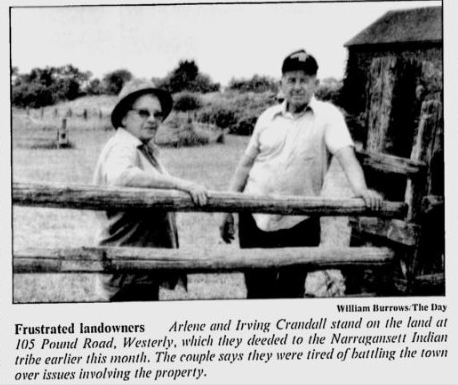
Forward to 1991, Crandall descendants Arlene and Irving Crandall return the land  (about 350 acres) to the Narragansett tribe. The 1991 Crandalls were behind in property taxes and nervous that the marshland, forest and swamp would be auctioned off  then developed into concrete, buildings and things. So the Crandall’s returned the land to the local tribe. Full story here: Taxes got too high they gave it back to the tribe.