John Parrish b. 1640

John Parrish 11th great grandpa on RootsMagic tree

John was born in 1640 probably near Braintree, Massachusetts. He first married Hannah Jewell, she died before 1685 when John married Mary Waddell. John and Mary were active in Groton, John holding many elected positions: selectman, town council, surveyor, constable.

  • 1669: Original proprietor in Groton, granted 5 acres of land
  • 1676 Mar 13: The couple lived in Groton when it was destroyed by Indian wars
  • 1677: John was on the committee to rebuild after the town evacuated then returned months later. The record from October 12, 1677, Pages 52, 53, The Early Records of Groton, Massachusetts: 1662-1707 at HathiTrust, “This is the last record of any meeting held before the destruction of the town by the Indians, March 13, 1676. The inhabitants then were compelled to forsake their homes, and did not return until the spring of 1678. …that those present would go up in the spring following, and begin to repair our habitations again… which agreement he signed”.
  • 1685 John received 10 acres of land in Groton. After rebuilding the town, John and probably Mary, both played a big part in getting a pastor and church to Groton.
  • 1691 Dec 21, “At the same day thay did apoint and by uoat daclare that sd Josiah parkar and sar John parish & Wiliam longly & sam James parkar should go down & fach up som meet parson to preach to us & the town is to bare the charg”.
  • 1692 March 21, “Groton at a genaral town meting legally warned the town did then by uoat datannan that thay would giue to master hancock the full som of sixtey pound one fourth part siluer for a yers salarey for Preaching in order to ordnation in dew time and the other three parts in pay corn or prouishon at comon pays and mr hancocock bored himself:  John Parish was chosen to dascors with mr hancock to see if he wil acs apt of the towns profr”.

groton-first-parish-meeting-house

Sources
Groton (Mass. : Town). The Early Records of Groton, Massachusetts: 1662-1707. Groton: [Town of Groton], 1880.

Parish, Roswell. New England Parish Families: Descendants of John Parish of Groton, Mass, And Preston…  Rutland, Vt.: The Tuttle Publishing Company, inc, 1938.

And some $ Ancestry sources, Marriages, North American Families.
Alice Ashton b. 1617

Alice Ashton 10th great grandmother maternal, sailed from St Albans, England to Virginia in 1635, she was about 20. At HathiTrust a list of passengers, “x? Aug 1635 Theis underwritten names are to be transported to Virginea, imbarqued in the Safety, John Graunt Mr, almost 3 pages of names, Alice Ashton 20.” These lists are published in a book: The original lists of persons of quality, emigrants, religious exiles, political rebels, serving men sold for a term of years, apprentices, children stolen, maidens pressed, and others, who went from Great Britain to the American plantations, 1600-1700. With their ages, the localities where they formerly lived in the mother country, the names of the ships in which they embarked, and other interesting particulars. From mss. preserved in the State Paper Dept. of Her Majesty’s Public Record Office, England, by John Hotten  published in 1832. That’s the actual title, generally shortened to The original lists of persons of quality, which is kind of worse.

Anyway Alice is sailing, she is the only Ashton on The Safety.

  • 1635 April Alice’s sister Mary Ashton 10th great grandmother, sailed with her husband Thomas Olney, and kids: Thomas age 1, Epenetus an infant. The Olneys left St Albans, England on the Planter 2 Apr 1635, then arrived in New England maybe mid May of 1635.
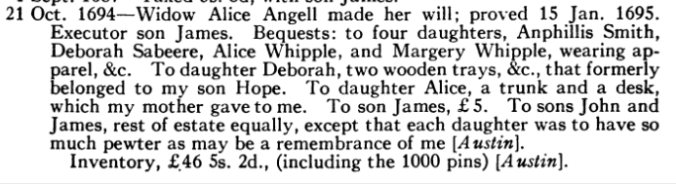
  • 1635 June on the ship with Alice “a trunk and a desk, which my mother gave to me”
  • 1635 August Alice probably joins her sister Mary’s family in colonial Massachusetts.
  • 1635 October In Providence is Thomas Angell who escaped with Roger Williams and 4 others in a canoe in the dark of night 08 Oct 1635.
  • 1637 Thomas Olney is a freeman and holds several Civil positions. He is also a baptist and associated with Roger Williams so is banished from Massachusetts.
  • 1638 Olneys and Ashtons follow Williams to Providence.
  • 1646 Thomas Angell and Alice marry
  • 1668 Angells and Olneys are some of the original settlers of Rhode Island and founders, members of the First Baptist Church.

Alice and Thomas Angell have eight children and long lives in Providence. They die in the same year 1694, Alice age 77, Thomas age 78. Alice Ashton Angell writes her will  and gives the trunk and desk which sailed with her from St. Albans to her namesake daughter Alice Angell who is 45 and married to Eleazer Whipple. Eleazer and Alice Angell Whipple may have had 10 children. They lived and died in Providence, Alice lived to age 94. Both are buried in the Whipple Mowry Cemetery also known as Rhode Island Historical Cemetery Lincoln 15.

Snapshot from page 75 The Providence oath of allegiance and its signers, 1651-2 at HathiTrust

ashton-alice-will

Ashton Angell, Alice will 1694


Sources

The Providence oath of allegiance and its signers, 1651-2 by Bowen, Richard LeBaron page 75 at HathiTrust

The Original Lists of Persons of Quality: Emigrants by Hotten, John Camden page 123 at HathiTrust.

Ruth Cable b. 1890

Ruth Cable, daughter of William Cable and first wife Nellie Stroud. Ruth was born in 1890 in Pleasant Valley township near Greene, Iowa. She lived on a farm with her dad and mom, younger sister Nora and older brother Leonard. School age Ruth and Leonard won school awards for perfect attendance- an accomplishment when a journey to country school was not as simple as hopping in a car and driving along paved roads. From the Marble Rock Journal 1904 Feb 4: Pupils neither tardy or absent: Leonard and Ruth Cable.

On March 21, 1908, ruth took a buggy to town for some shopping. She was at the Bucholz store in Greene, Iowa (Bucholz, owned by Bucholz and Dralle this store is still there as Dralle’s- they’re on Facebook). In the Iowa (Greene) Recorder of March 25, 1908 Ruth Cable leaves a message:

“Parcel Misplaced. A parcel containing a dark blue skirt and iron lead belt buckle with garnet setting was placed in wrong buggy last Saturday evening. Finder please leave at Bucholz store and receive liberal reward.” 

A few months after the missing parcel, William and Nellie were divorcing, all covered in the local newspapers. Their divorce was not friendly, accusations were made on both sides. The mom Nellie went  to Kansas City. Nora married, Leonard moved around the country. Ruth was a lodger in Waterloo, Iowa 1910, a store clerk at the Golden Rule. She married Walter Thomas in 1913, he died in 1920. Ruth married married Harold Lindberg in 1921. In 1926 Ruth and Harold of Ohio attended William Cable’s funeral in Greene, Iowa. Ruth’s last record is a 1927 Columbus, Ohio city directory. Harold Lindberg died in San Bernardino, California in 1961. Ruth’s death date and place are unknown.

Sources

Charles Angell b. 1825

Charles Angell, my 3rd great uncle on RootsMagic tree

Charles Angell was born in Utica, New York to Dexter Angell and Clementine Benight. He grew up in Prairieton, Indiana and by 1845 he was in Illinois where he married Eleanor Black on April 2. They had eight children and were farmers in Illinois then in Butler County, Iowa near Clarksville.

The 1870 US agricultural census shows Charles owned a 120 acre farm, valued at $4800. He had 4 horses, 5 milk cows, 5 other cows, 41 sheep and 17 swine. The farm produced 240 bushels of wheat, 350 of Indian corn and 180 of oats. 146 pounds of wool, 30 pounds of potatoes, 150 pounds of butter, 40 bales of hay and 40 gallons of molasses were also recorded.

Sources

  • U.S. Federal Census Non-Population Schedules, 1870; Butler, Iowa; -at Ancestry
  • New York, Wills and Probate Records, 1659-1999 Wills, 1792-1922at Ancestry

Elizabeth Salome Myers b. 1842

Elizabeth Salome (Sally) Myers married Henry F Stewart, 1st cousin 4 times removed, in about 1867. In the midst of the Civil War, Sally was a teacher in Gettysburg, PA. Most in Gettysburg understood the war could come closer to their homes, the Confederate Army was close by at Antietam. On July 1 of 1863  school was out for the summer and the battles began in Gettysburg. Sally was 21 and instantly became a nurse to the wounded and dying soldiers.

Alexander Stewart of the 109th Pennsylvania Volunteers was Sally’s first patient. She asked the soldier what he needed, he answered nothing. He understood he was going to die. Maybe Sally helped Alexander write a last letter to his family, she did this for many soldiers. Alexander’s family met Sally when they came to Gettysburg to pick up their son’s corpse. The Stewart family thanked Sally for all she had done. Later that summer Sally had a letter form Alexander’s brother Henry. Henry Stewart was a minister, he and Sally kept in touch. Eventually Henry and his mom moved to Gettysburg. Henry and Sally continued their friendship and then married.

Parts of Sally’s story are here at Civil War Sources and here at GettysburgTimes.com. I’ve just ordered Sally’s Gettysburg diary The Ties of the Past, on Ebay, thank you SeattleGoodwillBooks.

Stewart, Salome M, and Sarah S. Rodgers. The Ties of the Past: The Gettysburg Diaries of Salome Myers Stewart, 1854-1922. Gettysburg, PA: Thomas Publications, 1996. Print.


Hope Angell 1780 recruiting for the Revolution

July 1780 a Revolution in the making:
Be it therefore enacted by this General Assembly, that the persons here-after named be, empowered and directed, to form all male persons sixteen years and upwards, residing within their respective towns (deserters, Indians, mulattoes and negroes excepted), into classes; and each of the said classes is directed to furnish one able-bodied, effective man, by the 12th day of July instant.

And it is further enacted, that the following persons be appointed in the respective towns, for the purpose, afore-said, to wit: Names of Person appointed by the General Assembly for the several Towns to receive Recruits. North Providence Messrs. Eleazer Jenckes, Eleazer Whipple, Hope Angell, Thomas Olney and Christopher Whipple.

In 1780 Hope Angell 7th great uncle was 38, his older brother Israel  6th great grandfather was 40; and in the midst of the American Revolution which lasted, very generally, from 1774-1782. The above is from Records of the colony of Rhode Island and Providence Plantations, in New England : Printed by order of the General assembly at HathiTrust, specifically volume 9 of 10, pages 126-128.

At a previous session the second Monday in June 1780 (page 101), the Assembly voted to ‘raise’ 610 able bodied men for the state’s Continental battalions. By the first Monday in July 1780 assembly meeting, Rhode Island was still short in men, so groups were appointed, in each town to classify and enlist some men as soldiers.

This one assembly gathering goes on for pages, some items included:

  • Captain Stephen Olney, paymaster of Colonel Israel Angell’s battalion taking pairs of overalls and shirts to  men (page 134).
  • Monsieur Lewis Ethis de Corny, of the French Army unable to find a suitable house in Providence (page 120).
  • consequences for able men not doing their duty, money for men doing their duty.

The assembly ends (page 149) with: God save the United States of America, and letters written between William Greene, Governor of Rhode Island and General Washington.

Source

Elizabeth Harter b. 1795

Elizabeth Harter 5th great grandmother on RootsMagic tree

Elizabeth was born in 1795 in Beaver, Pennsylvania near Pittsburgh. At age 9 or so Elizabeth and her family set out for Ohio, ‘Early in the spring of 1806 the family of George Harter started from Beaver in a six-horse wagon for their new home in Ohio. A daughter, then in her ninth year, later Mrs. Jehu Grubb, had in after years a very distinct recollection of the journey out; of seeing the men at work digging the race for Slusser’s mill, as they crossed Nimishillen: of her great disappointment at the size of Canton, expecting to see it as large as Pittsburg-, when it contained only three cabins, all told.” Page 43 Old Landmarks of Canton and Stark Ohio at HathiTrust.

Part of Elizabeth’s childhood in Canton was working the family farm. At 15 she’s sent to the town mill with bushels of wheat. On Elizabeth’s horse is the lighter sack, also she’s leading a second horse with the heavier 3 pound sack. It’s a long day riding to the mill, then waiting at the mill. Elizabeth starts home closer to dark than she had hoped. Following the trail through the woods is more difficult without sunlight. She rides on with her milled wheat (flour- but not like 2016 flour) and two horses. At one point she strays from the trail and a tree bough sweeps the bag of flour off the second horse.

“Here was a new difficulty, and she was about at her wits’ ends : but the girls of that time did not readily yield to trifles, and Elizabeth dismounted and used her best endeavors to put the sack back to its place; she did succeed in getting it upon her shoulder, but her strength was not great enough to throw it over the horse ; she worried herself with it, however, a long time, and was about giving up in despair, with the thought of going back to Canton until morning, as she had yet several miles home, when an old settler, Frederick Rodacker, happened to come along, and threw the sack upon the horse.”

The old Mr. Rodacker offers Elizabeth a place to stay till morning, she accepts. Back home her mom Elizabeth Bowman Bair is worried and “she blew a horn for more than half the night, so that her daughter might discern the way to the house”.

Elizabeth Harter was married to Abraham Bair and a mom at 18. After marrying Abraham she wasn’t so much a housewife. She didn’t stay in the house but was outside with her husband clearing land, rolling logs and burning brush. She may have had 10 children total with Abraham and her 2nd husband Jehu Grubb. Elizabeth’s War of 1812 pension application and her record keeping were majorly responsible for 2nd husband Jehu Grubb being recognized as a son in the Grubb Family dynasty, Curtis Grubb was Jehu’s father. Jehu’s story is worth reading, on Wikipedia.

bair-house-jacob-hFirst child Jacob built this house (at Wikipedia, photo by Sanfranman59). It is part of the National Register of Historic Places listings in Stark County, Ohio. The home was probably built in 1869 in Elizabeth’s 73rd year. Jacob inherited land from his stepfather Jehu Grubb’s estate and built this house on that land.

Sources

Job Drake b. 1622 and Mary Wolcott b. 1622

Job Drake, 11th great grandfather married Mary Wolcott. Job was b. in Devon, England 1622/3. Mary was born in Tolland, England 1622/3. They both arrived at Boston in 1630 on the “Mary and John”. Job was 7, not sure who he arrived with. Mary was 8 and came with her family. [Source listed on Ancestry.com for these facts: SPEAR, BURTON W. “Passengers Aboard the Mary & John.” In The Second Boat (Pentref Press, Machias, ME), vol. 1:2 (Aug. 1980), pp. 4-8.]

It’s a coincidence they arrived in America on the same ship. Mary’s family ends up in Connecticut by 1636. Job’s family location is not known. On June 25, 1646 they marry, probably in Windsor, Connecticut. I wonder if they ever knew they arrived together in America- did people of those times talk about things like that in getting to know each other?

An even bigger coincidence is that this husband and wife die on the exact same day: September 16, 1689. Their double headstone is at FindAGrave in the Palisado Cemetery,
Windsor, Connecticut: Mrs. Marih Drake, Mr Job Drake.

Sources

U.S. and Canada, Passenger and Immigration Lists Index, 1500s-1900s Place: Boston, Massachusetts; Year: 1630; Page Number: 8. Listed as source for this $ source: “Passengers Aboard the Mary & John.”  by Spear, Burton, -at Ancestry $ 

U.S., Find A Grave Index, 1600s-Current, free via Ancestry. The Drakes

Joshua Tefft b. 1650 treason, maybe

Joshua Tefft (10th great uncle) was tried for treason, “The fact that he was known not to have attended church, a considerable offense to the strict Puritan sensibility of the United Colonials, was also used against him at his trial.” The United Colonials were loosely Massachusetts, Plymouth and Connecticut. These Colonials made a plan to take Rhode Island and the Narraganset tribe’s land as their own. Somehow this all gets mixed up in King Philip’s War and Joshua, living on his farm in Rhode Island with his son- his wife dies 2 days after giving birth- attempts to defend his farm, is captured by the fighting Narraganset tribe and held as a slave. That’s one story.

Or Joshua, living peacefully with his family was somehow wronged and left the family and colony to take up with the Indians whether out of spite or pride. He rose in rank to become an advisor to Metacomet, King Philip.

Or, according to some United Colonial Soldiers, Joshua Tefft’s deceased wife was of the Wamponoag tribe and Joshua joined forces with the Narragansets and Wamponoags and fired 20 shots against the colonists.

Definitely Joshua was taken to court. Roger Williams recorded Joshua’s court statements, most court records have been permanently lost. Joshua was definitely convicted of treason, hanged, drawn and quartered. Facts are scarce and it appears the verdict then January 1676 and today is still somewhat undecided. Joshua was the only person executed for treason in New England history. John Tefft (1oth great grandfather) is described as ‘losing his head’ at his son’s execution. John was either beheaded, overwhelmed with grief or could not recover Joshua’s actual head which was supposedly mounted on a stake or used ‘for sport’.

Joshua’s son Peter was about 6 years old when his uncle Samuel (9th great grandfather ) and Jireh Bull were appointed guardians to oversee Peter and his inheritance. Peter lived and grew up with Samuel and Elizabeth Jenckes Tefft. Joshua’s orphan son marries Sarah or Mary Witter they have children and hopefully a happy life.

Sources

Rhode Island Renegade: The Enigma of Joshua Tefft by Calloway, Colin in Rhode Island History. Vol. 43 (November 1984) PDF here pages 136 – 145 image 22 of 38. (This source provides a lot more sources including) 

The Narragansett Historical Register: a Magazine edited by Arnold, James N, Volume 3 pages 164 – 169 at HathiTrust.


Israel Smith b. 1689 and Elizabeth Arnold b. 1684

The wills of Israel Smith and his wife Elizabeth Arnold Smith Hawkins (8th great grandparents) contain inventories along with written wishes. Israel was a yeoman or landowner. He died at 37 in 1726. His inventory included: books, livestock, tools, seeds, a gun, a feather bed, blankets, linens, clothing, kitchenware, including pewter platters, 10 pounds of woolen yarns, thirty eight pounds of flax, spinning wools, furniture, tobacco and candlesticks.

Elizabeth outlived 2 husbands, she died at 74 in 1758. She left specific items for her daughters and granddaughters. Naomi Smith Angell inherited a Square Table and five pounds old Tenor. Daughter Elizabeth received the Long Cloke, Deborah got the Kettle and divided the featherbed with Ruth. Elizabeth’s will directed that her best buttons were for her granddaughters, “My will is that my Grand Daughter Elisabeth Hopkins have my large Silver Sleeve Buttons. Item, I give my Grand Daughter Martha Smith my Small Silver Sleeve Buttons, my looking Glass.”

Elizabeth’s will was transcribed at Rhode Island USGenweb, part of RootsWeb, a goldmine of early online family history collaboration begun in 1996, a free collaborative site, then purchased by Ance$try with a promise of preservation. Some of RootsWeb exists, a lot is erased.

Sources

  • Providence, Rhode Island, Wills (1678-1916) and Indexes, Volume 3-4, 1726-1754, page 121, 122, 123, 124 at Ancestry
  • Broken link. Rhode Island USGenWeb Project, Rhode Island Reading room Wills page 4 public document transcribed at: http://www.rootsweb.ancestry.com/~rigenweb/wills4.html