Violetta Cable b. 1857

Cable, Violet obituary 1942Violetta Cable, great grand aunt on RootsMagic tree

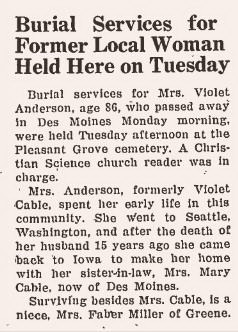
Violetta was born April 11, 1857 in Wisconsin to Jonathan Cable, her mom was probably Eliza Frey. Violetta was the youngest of 5 kids with 3 brothers and a sister. By 1870 Violetta was 13 and living with her family in Pleasant Grove, Iowa. She lived on a farm in Pleasant Grove until about 1884 when she was a postmaster in Cable, Minnesota. This is noted on Wikipedia and also in a book: Minnesota Place Names by Upham.

Violetta took in her niece and nephews: Ethel Towslee, Chauncey and Leonard Cable all lived with her at different times in Chicago, Minnesota and Seattle. Violetta married Charles Anderson in 1908 in Seattle. She was 51 he was 39, Charles died in 1927, they didn’t have children. As a widow Violetta lived with her brother William’s widow, Mary Fries Cable in Des Moines, Iowa. Violetta died in Des Moines April 6, 1942 and is buried in the Pleasant Grove, Iowa cemetery, headstone not yet located, probably near her brother William.

Sources

Oscar Speedy b. 1867

Oscar Alexander Speedy 2nd great uncle on RootsMagic tree.

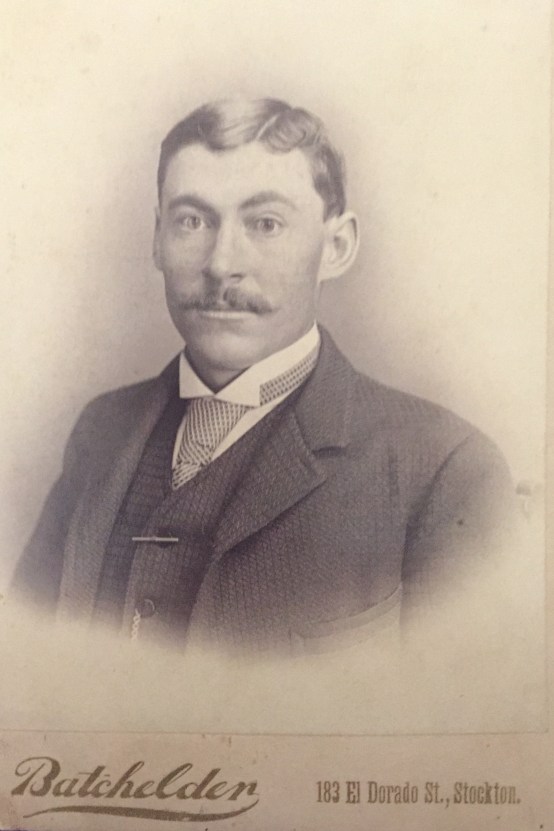
Speedy, Oscar in Stockton California

Oscar’s parents were Manford and first wife Ann Coats Speedy. Ann died of typhoid fever in 1869, Oscar was 2. His 2nd mom was Elizabeth Stewart Speedy. Oscar grew up in Butler County, Iowa. He attended school and lived on a farm. By 1888 at age 21 he was out west in Stockton, San Joaquin County, California. He was first a miner then an engineer at the Stockton Jackson Baths, mineral baths. “The facility included twelve bath houses for private parties, a clubhouse for entertaining and a grand stand for musical concerts. The thirteen acre resort destination also featured lawn areas with picnic tables and barbecue pits, and even a small zoo and a scenic railway.” Article by Alice Van Ommeren, 2014 . The baths ended in the 1940s.

Speedy, Oscar Stockton, CA

Jackson Baths in Stockton California

Oscar is on the California Voter Lists in 1888 and 1892, not yet found on a census in California. ON voter lists Oscar is described “5′ 10″ dark complexion, hazel eyes, brown hair”.

He is not mentioned in his dad Manford’s 1914 obituary so may have died before 1914, not sureUpdate Fall 2019, Oscar Speedy has a Find a Grave memorial with details. At Find a Grave: Oscar A. Speedy is buried in Block 27N, Row G, Lot 164. He died in 1895, he was 28 years old. There’s no grave marker or death certificate, details. Burial information was provided by Cathleen Boccia, an employee of the Stockton Rural Cemetery, memorial created by “lawman on 29 Jun 2019”.

Sources

Faber J Druckenbrod b. 1899

Faber J Druckenbrod 1st cousin 3x removed on RootsMagic tree.

Faber was born on February 23, 1899 in Stark County, Ohio to Ivy and Elta Combs Druckenbrod. Faber was the nephew of Fianna Druckenbrod, mother of Lola Miller. Lola and Faber were cousins.

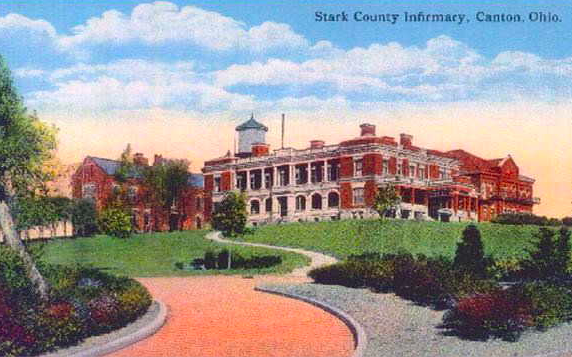
Stark County Infirmary

Faber’s dad, Ivy was Superintendent of the Stark Infirmary. The family lived at the infirmary, a huge stone mansion, when Faber and his brother were kids. Ivy died in 1916 and his widow Elta began traveling. In 1920 Elta sailed from Key West, Florida to Cuba. In 1924 she sailed from New York to Cherbourg, France. Elta and Faber made this European trip together with Faber staying longer in Europe. The photos are from their passport applications.


In 1939 Elta, Faber and Faber’s fiance Grace, visited Greene, Iowa. They spent a weekend with Lola Miller and her husband William E Miller. William and Lola had a son named Faber, it’s a pretty strong probability that Faber Miller with his wife Gladys Cable Miller, shared a dinner on Friday night September 29, 1939. Faber and Gladys named their first son Faber, too.

Druckenbrods visit Greene

Druckenbrods visit Greene, Iowa

Faber J Druckenbrod (1899 – 1958) son of Ivy Benton Druckenbrod (1862 – 1916) brother to Fianna Druckenbrod (1854 – 1923), Lola M Miller (1880 – 1951), Faber W Miller (1905 – 1957) m. Gladys Mae Cable (1913 – 1991)

Sources


Jabez Dewey b. 1755

Jabez Dewey born in 1755, probably in Connecticut, had joined the American Revolution by 1776 at age 21. He fought in the Battle of Harlem Heights, September 1776. The  battle was the first real victory of General Washington. “Upon receiving Washington’s orders to return to their lines, the troops gave a loud -huzzah- and left the field in good order.” Page 86, Johnston, Battle of Harlem Heights, 1897.

Jabez’s next battle was at Fort Washington in November 1776 and one of the worst defeats in the Revolution. Jabez along with 2,837 men were captured by the British then held on a prisoner of war ship. He died on this war ship probably in 1776. In his short life Jabez didn’t marry and didn’t see America freed from British rule. Forward to November 16, 1901 a dedication of a Fort Washington monument, Jabez’s relative Admiral George Dewey is recognized for his accomplishments in the Spanish American War. Page 21, Sons of the American Revolution, Fort Washington 1902

This Dewey family in America descended from Thomas Dewey b. 1613 and is researched well in: Dewey, Adelbert M. Life of George Dewey, Rear Admiral, U.S.N.; And Dewey Family History Westfield, Mass.: Dewey publishing company, 1898

Sources

Chancey Cable b. 1850

Chancey Cable, 2nd great uncle on RootsMagic tree.

Chancey was born April 1850 in Wisconsin, the 2nd son of Jonathan Cable and Eliza Frey. In 1870 his family lived on a farm in Pleasant Grove, Floyd County, Iowa. Chancey is in the local news papers in 1877, at the 4th of July celebration he won a race and played on the baseball team. Chancey and older brother John owned a saloon in Greene, Iowa.

In 1880 Chancey was in Chippewa, Wisconsin living in a boarding house with siblings John and Sarah. John and Chancey were Railroad Contractors. Sarah kept house with 35 boarders including Sarah’s husband Horace Towsley. On the 1880 census Chancey was a widow. If he ever married, it was for a very short time with no record yet of his wife and no known children. In 1885 Chancey  was in St. Paul, Minnesota. His brother John was there too, married and soon to have a son he would name Chancey.

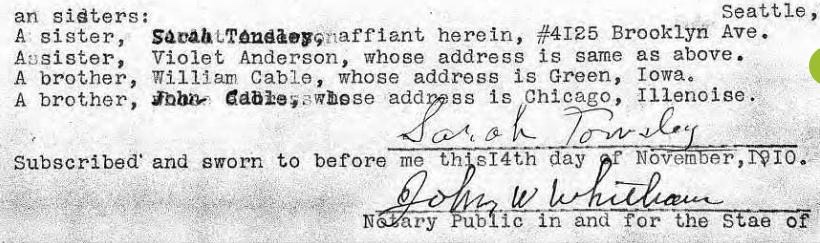
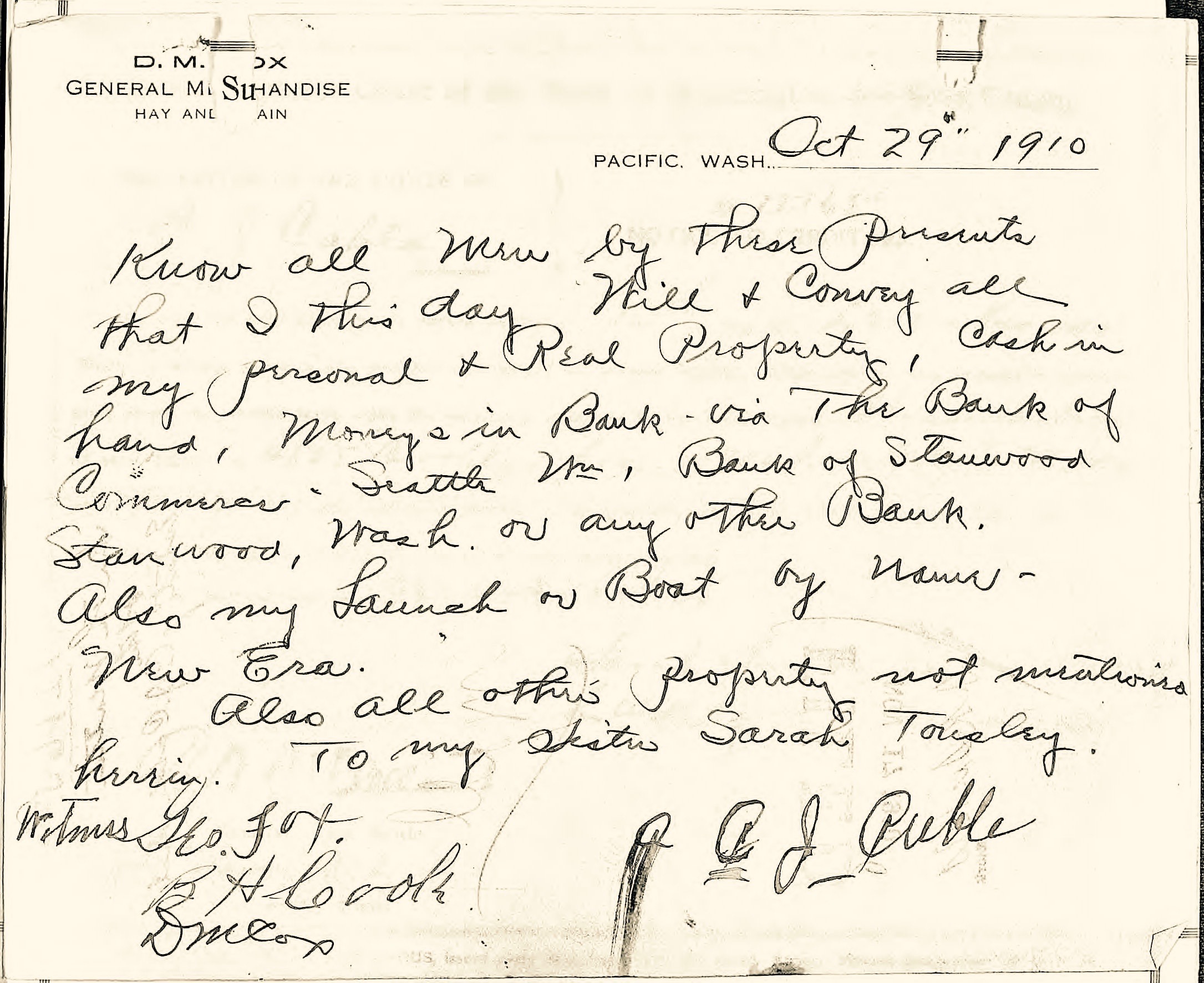
By 1900 Chancey was further west in Sunshine, Colorado, on his own, a gold and silver miner. In 1910 he lived in Port Townsend, Washington on the northwest corner near Victoria and Vancouver,  Canada. He owned a tugboat named “New Era”. When Chancey died on October 30, 1910 his probate named each of his siblings and his handwritten will left everything to his sister Sarah Cable Towsley.

Will, listing Chancey’s siblings.

Cable- Chancey handwritten will

Chancey’s handwritten note, a will.


Sources

    • Washington death certificates 1907-1960 at FamilySearch.org

    • At Ancestry.com: Minnesota, Territorial and State Censuses, 1849-1905, Washington, Wills and Probate Records, 1851-1970, 1900 US Census, 1880 US Census.

Benedict Arnold b. 1614, the Govr’s son

screenshot.png

Photo at Rhode Island Historical Cemetery Commission

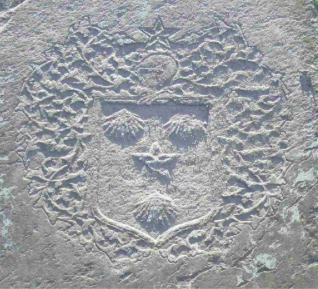
Benedict the 2nd born about 1641 has this headstone with the family crest, three shells, a center star and (not shown) a rose in each corner. This is gorgeous and indexed at the Rhode Island Historic Cemetery Commission : the stone was “carved by John Stevens II and lettered by his brother Philip”. Benedict, other Arnolds and Arnold in laws are at the Governor Arnold Burying Ground in Newport, Rhode Island, in a residential area, a tiny cemetery with less than 70 memorials. On Google maps it appears next to a private home with a bike parked on the side fence and a Starbuck’s within 100 feet or so.

There were five Benedict Arnolds in this family in the early days of America.

Benjamin 1- born 1615, son of William and Christiana Peake Arnold, married Damaris Westcott. He became President then Governor of Rhode Island. Father of

Benjamin 2- born about 1641 married Mary Turner, then Sarah Mumford. Parents of

Benjamin 3- born 1683 married Patience Coggleshall. Parents  of

Benedict 4- born 1719 married Hannah Waterman. Parents of

Benedict 5- born 1741 married Margret Shippen. This Benedict is the one of the American Revolution, labeled a traitor. He is buried in London, at St. Mary’s of Battersea, where William Blake was married, near the river Thames. Changes in Longitude has a full article and a comment section with many opinions about Benedict 5s actual crimes and intentions.

Benjamin 5s mom Hannah Waterman is buried at Old Norwichtown Cemetery in Norwich, Connecticut. This family suffered. From 1738-1755 four of six children died of yellow fever. For some reason, maybe the death of four children, the dad Benedict 4 drank, a lot. By 1756 the life planned for great-grandson of the Govr Benedict 5, private schools then Yale, was dashed, the money was gone, the family somewhat scorned by their community because of the dad’s drinking. Hannah the mom died in 1759, the dad drank more and died soon after. Benedict 5 got an apprenticeship with his mom’s side of the family, then the rest is history.

Hannah’s grave has an anonymous admirer who decorates the grave about once each year, 2011 story here: An anonymous admirer has once again shown devotion to the mother of one of history’s most infamous figures with a gift of flowers and light.

Ruth Cable b. 1890

Ruth Cable, daughter of William Cable and first wife Nellie Stroud. Ruth was born in 1890 in Pleasant Valley township near Greene, Iowa. She lived on a farm with her dad and mom, younger sister Nora and older brother Leonard. School age Ruth and Leonard won school awards for perfect attendance- an accomplishment when a journey to country school was not as simple as hopping in a car and driving along paved roads. From the Marble Rock Journal 1904 Feb 4: Pupils neither tardy or absent: Leonard and Ruth Cable.

On March 21, 1908, ruth took a buggy to town for some shopping. She was at the Bucholz store in Greene, Iowa (Bucholz, owned by Bucholz and Dralle this store is still there as Dralle’s- they’re on Facebook). In the Iowa (Greene) Recorder of March 25, 1908 Ruth Cable leaves a message:

“Parcel Misplaced. A parcel containing a dark blue skirt and iron lead belt buckle with garnet setting was placed in wrong buggy last Saturday evening. Finder please leave at Bucholz store and receive liberal reward.” 

A few months after the missing parcel, William and Nellie were divorcing, all covered in the local newspapers. Their divorce was not friendly, accusations were made on both sides. The mom Nellie went  to Kansas City. Nora married, Leonard moved around the country. Ruth was a lodger in Waterloo, Iowa 1910, a store clerk at the Golden Rule. She married Walter Thomas in 1913, he died in 1920. Ruth married married Harold Lindberg in 1921. In 1926 Ruth and Harold of Ohio attended William Cable’s funeral in Greene, Iowa. Ruth’s last record is a 1927 Columbus, Ohio city directory. Harold Lindberg died in San Bernardino, California in 1961. Ruth’s death date and place are unknown.

Sources

Charles Angell b. 1825

Charles Angell 4th great uncle, Delia’s older brother farmed in Iowa from about 1850 until the turn of the century. By 1852 Charles was married to Eleanor Black, they may have married in Illinois. They had at least two children, Leander and Mary Alice. In 1854 Charles inherits a quarter of his father Dexter Angell’s estate which may have been substantial. In 1870 Charles’s 120 acre farm is valued at $4800. He keeps 4 horses, 5 milk cows, 5 other cows, 41 sheep and 17 swine. The farm produces 240 bushels of wheat, 350 of Indian corn and 180 of oats. 146 pounds of wool are produced along with 30 pounds of potatoes and 150 pounds of butter; 40 bales of hay and 40 gallons of molasses.

Sources

U.S. Federal Census Non-Population Schedules, 1870; Butler, Iowa; Archive Collection Number: T1156; Roll: 6; Page: 1; Line: 23; Schedule Type: Agriculture -at Ancestry $.

New York, Wills and Probate Records, 1659-1999 Wills, 1792-1922; New York. Surrogate’s Court (Chenango County); Chenango, New York -at Ancestry $

Hope Angell 1780 recruiting for the Revolution

July 1780 a Revolution in the making:
Be it therefore enacted by this General Assembly, that the persons here-after named be, empowered and directed, to form all male persons sixteen years and upwards, residing within their respective towns (deserters, Indians, mulattoes and negroes excepted), into classes; and each of the said classes is directed to furnish one able-bodied, effective man, by the 12th day of July instant.

And it is further enacted, that the following persons be appointed in the respective towns, for the purpose, afore-said, to wit: Names of Person appointed by the General Assembly for the several Towns to receive Recruits. North Providence Messrs. Eleazer Jenckes, Eleazer Whipple, Hope Angell, Thomas Olney and Christopher Whipple.

In 1780 Hope Angell 7th great uncle was 38, his older brother Israel  6th great grandfather was 40; and in the midst of the American Revolution which lasted, very generally, from 1774-1782. The above is from Records of the colony of Rhode Island and Providence Plantations, in New England : Printed by order of the General assembly at HathiTrust, specifically volume 9 of 10, pages 126-128.

At a previous session the second Monday in June 1780 (page 101), the Assembly voted to ‘raise’ 610 able bodied men for the state’s Continental battalions. By the first Monday in July 1780 assembly meeting, Rhode Island was still short in men, so groups were appointed, in each town to classify and enlist some men as soldiers.

This one assembly gathering goes on for pages, some items included:

  • Captain Stephen Olney, paymaster of Colonel Israel Angell’s battalion taking pairs of overalls and shirts to  men (page 134).
  • Monsieur Lewis Ethis de Corny, of the French Army unable to find a suitable house in Providence (page 120).
  • consequences for able men not doing their duty, money for men doing their duty.

The assembly ends (page 149) with: God save the United States of America, and letters written between William Greene, Governor of Rhode Island and General Washington.

Source

Joshua Tefft b. 1650 treason, maybe

Joshua Tefft (10th great uncle) was tried for treason, “The fact that he was known not to have attended church, a considerable offense to the strict Puritan sensibility of the United Colonials, was also used against him at his trial.” The United Colonials were loosely Massachusetts, Plymouth and Connecticut. These Colonials made a plan to take Rhode Island and the Narraganset tribe’s land as their own. Somehow this all gets mixed up in King Philip’s War and Joshua, living on his farm in Rhode Island with his son- his wife dies 2 days after giving birth- attempts to defend his farm, is captured by the fighting Narraganset tribe and held as a slave. That’s one story.

Or Joshua, living peacefully with his family was somehow wronged and left the family and colony to take up with the Indians whether out of spite or pride. He rose in rank to become an advisor to Metacomet, King Philip.

Or, according to some United Colonial Soldiers, Joshua Tefft’s deceased wife was of the Wamponoag tribe and Joshua joined forces with the Narragansets and Wamponoags and fired 20 shots against the colonists.

Definitely Joshua was taken to court. Roger Williams recorded Joshua’s court statements, most court records have been permanently lost. Joshua was definitely convicted of treason, hanged, drawn and quartered. Facts are scarce and it appears the verdict then January 1676 and today is still somewhat undecided. Joshua was the only person executed for treason in New England history. John Tefft (1oth great grandfather) is described as ‘losing his head’ at his son’s execution. John was either beheaded, overwhelmed with grief or could not recover Joshua’s actual head which was supposedly mounted on a stake or used ‘for sport’.

Joshua’s son Peter was about 6 years old when his uncle Samuel (9th great grandfather ) and Jireh Bull were appointed guardians to oversee Peter and his inheritance. Peter lived and grew up with Samuel and Elizabeth Jenckes Tefft. Joshua’s orphan son marries Sarah or Mary Witter they have children and hopefully a happy life.

Sources

Rhode Island Renegade: The Enigma of Joshua Tefft by Calloway, Colin in Rhode Island History. Vol. 43 (November 1984) PDF here pages 136 – 145 image 22 of 38. (This source provides a lot more sources including) 

The Narragansett Historical Register: a Magazine edited by Arnold, James N, Volume 3 pages 164 – 169 at HathiTrust.