Sarah Towne b. 1658

Unrelated (2nd wife of 9th great grandfather) but what a story, Sarah Towne on RootsMagic tree.

Sarah Towne Bridges Cloyes, had 2 sisters Rebecca and Mary, who were tried and  jailed during the Salem witch trials. After defending her sister Rebecca Nurse and being so frustrated by the implausibility or stupidity of the situation, she walked out of the church and purposefully slammed the door– most likely never, ever done before or since? After slamming the church door Sarah is also accused of being a witch.

All three sisters: Sarah Towne Cloyes, Rebecca Towne Nurse and Mary Towne Easty are put in jail. Rebecca, 71 and Mary, 58 were both hanged in 1692.  Ann Putnam, age 13, had accused 62 women of witchcraft. In 1706 she publicly apologized for her lies, her actions and specifically the harm she caused for the Towne sisters and their families. The Towne family forgave Ann Putnam.

Sarah’s husband Peter either helped Sarah escape from jail or he paid for Sarah’s release, details are sketchy. Sarah and Peter went southwest to Danforth’s Plantation, now Framingham. They probably knew this was a safe place and later on received land from Deputy Governor Thomas Danforth who released 800 acres to families fleeing Salem. There is so much history to the Salem witch hysteria. A person could spend years reading the surviving primary documents and research on those involved. 

Author Nathaniel Hawthorne’s book Young Goodman Brown refers to Sarah Cloyes. Word is the author changed the spelling of his name so he wouldn’t be associated with John Hathorne, his great great grandfather and the only judge not to apologize or question his role in the horror of the Salem witch hysteria. screenshot.png
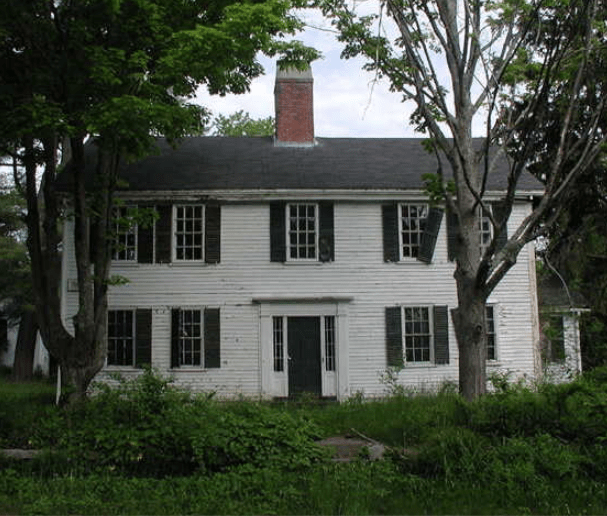
The home of Sarah and Peter Cloyes built ca. 1690 is still standing and currently going through majors restoration. The house is at 657 Salem End Road, Framingham, MA; visit the restoration website*update* The restoration site is still there but as of Feb 2019 this house is redone and on the market for $900,000. *update* On the outside the house looks about the same, inside it looks like any other newer home, bright and shiny, but maybe lacking character.

At Wikipedia Salem witch trials:

The episode is one of Colonial America’s most notorious cases of mass hysteria.

It has been used in political rhetoric and popular literature as a vivid cautionary tale about the dangers of isolationism, religious extremism, false accusations, and lapses in due process.

Elizabeth Tilley b. 1607

Jabez Howland house

Postcard. The Howland House, 1666, Plymouth, Mass.

I’ve added Mayflower passengers to my family tree. Elizabeth Tilley 10th great grandmother, at age 13 sailed on the Mayflower with parents John and Elizabeth Joan Hurst Tilley. The older Tilley children stayed in England. Both John and Joan died in the general sickness of the first winter, 1621. Orphaned Elizabeth was taken in by John Carver (Plymouth Colony governor). Carver had a man-servant or secretary John Howland. When both John Carver and his wife died in early spring of 1621, John Howland inherited their estate and Elizabeth Tilley became his ward, they soon married and had 10 children who all survived into adulthood, so today Tilley and Howland have millions of descendants -you could be one too.

Rocky Nook was John and Elizabeth’s home, it’s no longer around but the land is preserved with a monument and trees, a stone wall and cellars original to the Howland home. The Pilgrim John Howland Society and the Plymouth Archaeological Rediscovery Project share their findings which reveal much history: the Howland House Bake Oven and a 50 page report on 2015 excavations including an artifact catalog are 2 examples. More than 4750 artifacts have been uncovered on the lands.

John and Elizabeth’s son Jabez lived in a home at 33 Sandwich Street in Plymouth, Massachusetts. The home still stands today . John and Elizabeth lived with Jabez after their home burned. So a person could today walk through this Jabez Howland home in the footsteps of Mayflower passengers John and Elizabeth Tilley Howland. Fascinating.

The Jabez Howland House is the only existing house in Plymouth where Pilgrims actually lived. The original 17th century two-story timber framed house consisted of the porch, hall and hall chamber. John Howland and his wife, Elizabeth Tilley Howland spent their winters here with their son Jabez and his family.

John Crandall b. 1612 taxes got too high in 1991

Newly added John Crandall (10th great grandfather) was a Baptist elder, very vocal in his beliefs and ideas of fairness. He was summoned and fined by the courts for holding religious meetings, resisting authority, sedition and rebellion. Oddly he was also Deputy Commissioner and Statesman. In 1661 Crandall purchased land from the Narragansett tribe in Rhode Island. This tribe’s language was studied and recorded by Roger Williams in his book A Key Into the American Language.

screenshot-3

Forward to 1991, Crandall descendants Arlene and Irving Crandall return the land  (about 350 acres) to the Narragansett tribe. The 1991 Crandalls were behind in property taxes and nervous that the marshland, forest and swamp would be auctioned off  then developed into concrete, buildings and things. So the Crandall’s returned the land to the local tribe. Full story here: Taxes got too high they gave it back to the tribe.


Thomas Burnham b. 1617

Thomas Burnham 10th great grandfather on RootsMagic tree

Thomas was maybe  a passenger on the Angel Gabriel in 1635. Thomas’s uncle Robert Andrews (mother’s brother) was Captain. The ship sailed from England directly into the strongest hurricane ever to hit Massachusetts. The Great Colonial Hurricane of August 25-26th, 1635 was a Category 3 (like Katrina 2005).  Governor Bradford wrote of a 20′ tide slamming into Boston. The Angel Gabriel was tossed and turned, passengers began throwing possessions overboard, lightning their load, hoping to make it to the (now) Pemaquid, Maine coast. All but perhaps 100 passengers made it safely to the colonies. A trunk survived- it belonged to John Cogswell and is on display at the Colonial Pemaquid State Historic Site, Bangor Daily News has a story. Some genealogy books tell of the Burnham brothers losing all their possessions during the storm.

Once safely settled in America Thomas was involved in civic affairs. He was a constable and also a lawyer. His most famous case was defending teacher Abigail Betts who called Jesus a bastard and was charged with blasphemy. Thomas defended Abigail by proving England did not consider blasphemy a crime so America, England’s colony, could not consider blasphemy a crime. Thomas then had to defend himself for defending Abigail. He called for “Justice according to Law” and the separation of the church and the state. Thomas may have lost his citizenship for awhile and he could no longer appear in the courts of the time. Before his death he had deeded his land to his children. He may have written a will, it was never found, maybe his wife Ann Wright refused to share it?, his will was recreated through witness testimony. Much detail here at HathiTrust page 121 of Genealogical Records of Thomas Burnham, the emigrant.

Francis Sprague b. 1590

Francis Sprague 10th great grandfather on RootsMagic tree

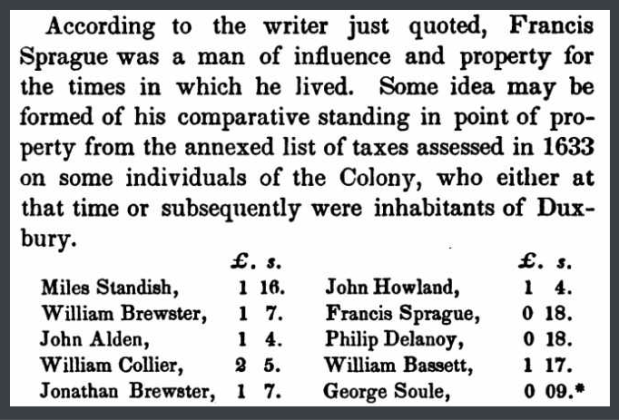
Francis, along with daughters Anna (most likely a daughter, could have been a wife) and Mercy sailed on the Anne in 1623 from England to the Plymouth Colony. It was a summer voyage lasting about 3 months.

Wikipedia article, Passengers of the ships Anne and Little James 1623 has more detail. “From these statements … the reason so many of the first arrivals disappeared from Plymouth … many of the emigrants on the Anne and Little James would eventually be sent back to England as unfit for the task of living and working in a harsh colonial environment.” William Bradford’s history tells of his dismay at some of the passengers sent. “And some were so bad, as they were faine to be at charge to send them home again next year.”

Francis Sprague got to stay. He was a freeman, an innkeeper licensed to sell liquor and he owned land.

screenshot.png

Snapshot from Memorial of the Sprague family by Soule, Richard page 30 at HathiTrust

Godsgift Arnold b. 1658 and Jireh Bull b. 1659

Bull, Jireh and Godsgift house

Godsgift Arnold 1st cousin 9 times removed from Elizabeth Speedy who married Stanley Roose Sr.

Godsgift was born on 27 Aug 1658 in Newport, Rhode Island, USA to Benedict (11th great uncle) and Damaris Westcott Arnold, the governor. Benedict Arnold who joined the British Army was her great grand nephew. Godsgift married Jireh Bull, their grandfathers William Arnold and Henry Bull were original Rhode Island settlers in the 1630s. Godsgift and Jireh lived in Newport, Rhode Island in a home still standing, now known as The Captain John Maudsley House. In 1952 it was discovered that the house was actually built by Jireh Bull. The August 27, 1952 Newport News tells the house’s history, I haven’t found the actual source. The Library of Congress has photos and floor plans of this house that Jireh started building in 1680. The house is still standing and privately owned today, at Wikipedia . 

The photo is from early 1900s. Jireh began building in 1680.  At the Library of Congress: John Maudsley House, Other Title Jireh Bull House.

William Flood in Civil War 1862

William Flood, 3rd great grandfather, married to Delia Angell, was a Civil War soldier in the Iowa 32nd Infantry. He registered after Governor Kirkwood on July 9, 1862 made a proclamation calling for 300,000 Iowa men to join the war effort. At HathiTrust in the Roster and record of Iowa soldiers in the war of the Rebellion, Volume 5 (William’s info is on page 57) there is a 10-20 page description of the the soldiers’s battles and movements. They walked from Iowa to Nashville, Arkansas, Missouri, Alabama. They walked in soldier’s uniforms with their supplies on their backs.

Today in Iowa it is 90 degrees, heat index 104. I carried out the garbage/recycling in a tank top, flip flops, shorts with no gear on my back. I broke a sweat- WTF? Were these ancestors of mine a different species? How in the world did they do what they did, everyday.

Frerichs family emigrates in 1883

In 1883 Enno Frerichs (2nd great grandfather) and family sailed from Bremen, Germany to Baltimore, Maryland. From Baltimore they would have taken a train to Freeport, Illinois joining friends and family already settled in America. Railroad companies produced pamphlets many in  German, advertising the lands for sale in the Plains: Illinois, Iowa, Kansas, Nebraska. Local agents were listed along with details about crops, social life, religion and the financial make up of the specific towns. Railroads and the Making of Modern America University of Nebraska Lincoln is an educational site with plentiful sources.


Bradford Hale b. Jan 1844

Bradford Hale 1st cousin 2 times removed or 2 generations back from Elizabeth Speedy who married Stanley Roose.  Bradford Hale on RootsMagic tree.

Bradford Hale was born in Prairieton, Vigo, Indiana. His father’s family, the Hales, and mother’s family, the Angells, were original settlers in Prarieton. Bradford’s grandfathers are featured in the book “History of Vigo and Parke Counties together with historic notes on the Wabash Valley, gleaned from early authors, old maps and manuscripts, private and official correspondence, and other authentic, though, for the most part, out-of-the-way sources” by H. W. Beckwith. Available at the Vigo County Public Library and on Ancestry.com .

In 1862, at age 18 Bradford enlisted and entered the Civil War. He was part of three regiments:
33rd Regiment, Indiana Infantry
54th Regiment, Indiana Infantry (3 months, 1862)
85th Regiment, Indiana Infantry

The 85th regiment “took part in all the operations before Atlanta and was present at its fall. It engaged in the destruction of railroads and also in the building of roads and bridges.”  Source: Index with transcription Historical Data Systems, comp. U.S., American Civil War Regiments, 1861-1866 [database on-line]. Provo, UT, USA: Ancestry.com Operations Inc, 1999.

Bradford ended up at the infamous Confederate Andersonville Prison or Camp Sumter- known for seriously inhumane conditions. Bradford was exchanged the day President Abraham Lincoln died April 15, 1865. The camp was officially liberated May 1865 and today it’s a National Historic site in Georgia, at Wikipedia Andersonville Historic site.

After the war Bradford worked, married later in life and had a daughter. By 1885 he was 44 and a rancher in Chafee Colorado. 

Part of Bradford Hale’s military record at the National Park Service, Civil War Soldiers and Sailors System, online.

Name: Bradford Hale
Enlistment Date: 18 Jun 1862
Rank at enlistment: Private
State Served: Indiana
Survived the War?: Yes
Service Record: Enlisted in Company F, Indiana 54th Infantry Regiment on 18 Jun 1862.Mustered out on 18 Sep 1862 at Indiana

Name: Bradford Hale
Side: Union Regiment
State/Origin: Indiana
Regiment Name: 85 Indiana Infantry.
Regiment Name Expanded: 85th Regiment, Indiana Infantry Company: E
Rank In: Private
Rank In Expanded: Private
Rank Out: Private
Rank Out Ex –

Civil War Trust Saving America’s Battlefields provides maps, photos and great detail on the Civil War.

A copy of Bradford’s headstone application c. 1936. Bradford’s great grandfather was Israel Angell, a Revolutionary War Colonel who wrote to and received letters from General George Washington. I wonder if Bradford knew this.

screenshot

Hale, Bradford. U.S. Headstone Applications for Military Veterans, 1925-1963

National Archives at Washington, D.C.Applications for Headstones,
compiled 01/01/1925 – 06/30/1970, documenting the period ca. 1776 – 1970
ARC: 596118. Records of the Office of the Quartermaster General, 1774–1985,
Record Group 92. National Archives and Records Administration, Washington, D.C.

Lizzie Flood b.1867

Elizabeth Matilda Flood great aunt of Elizabeth Speedy who married Stanley Roose. Lizzie on RootsMagic tree.

Elizabeth went by Lizzie and was born January 28, 1867 in Butler County, Iowa. The year she was born, Harvard opens the 1st dental school, Nobel files a patent on dynamite, Nebraska becomes a state and Charles Dickens gives 1st public reading in the US.

screenshot 2Lizzie was a dressmaker. She was single and rented her home, in Iowa around 1900. Did she wish to stay single, did she have marriage proposals that she refused?  Did her parents hassle her to get married, start a family and settle down? Three of her sisters married and had children, one did not. Both her brothers married.

Lizzie died at about 36  years old, following an operation. She is buried near her family: mother Delia Viola Angell and father William Flood, brothers and sisters in an old cemetery near Clarksville, Iowa.

Postcard Waterloo, Iowa US HistoricalI think Lizzie liked living with her four sisters, two brothers and parents but was restless to be on her own. So she moved out of her family’s small town home at 20 years old and went to the closest city, then lived on her own until her death. Maybe she was a successful dressmaker during the day, then at home in the evenings she designed her own dresses and pondered opening her own dress shop. After Lizzie’s death her youngest sister, Nettie, owns a millinery shop. Perhaps Lizzie’s estate left all to her sister?

Flood, Lizzie swatch book

Lizzie may have kept a notebook similar to this Swatch book where she recorded her ideas for dress designs and her knowledge of textiles and sewing.

The Swatch book is at Winthur.org in their Digital Collections.

“Swatch Book :: Textile Patterns and Designs.” Swatch Book :: Textile Patterns and Designs. Winterthur Digital Collections, n.d. Web. 05 Jan. 2016.