History and Law, Sources and Evidence

This incredibly helpful and well-written article “Evidence and Sources and How They Differ” by Donn Devine adds another level of confusion to the citation and documentation of citing sources in genealogy. The article is in Ancestry Magazine May/June 1997, available on Google Books.
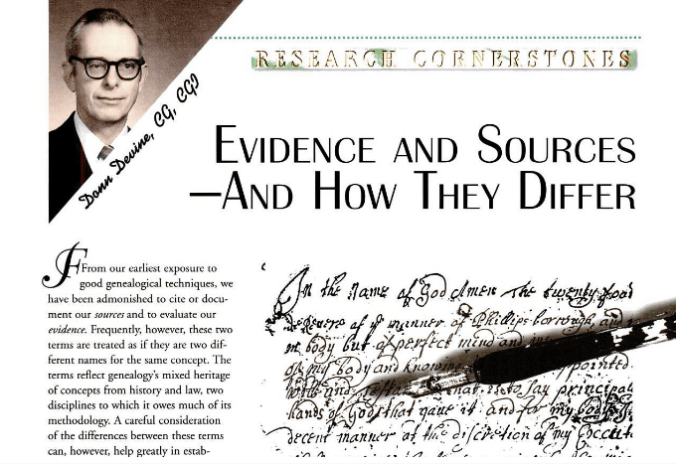
screenshot 2

My summary: The concept of source comes from social sciences, history and is the means by which information comes to a researcher, the container or vessel. Primary sources are the earliest or first pieces of recorded information. Secondary are published works, electronic, copied, compiled or reflecting the conclusion of a researcher.

The concept of evidence comes from law as in wills and probates. Evidence is the physical form in which information is presented to the senses and comes in 3 forms

  • testimonial
  • documentary
  • physical

The testimonial and documentary evidence has to be given with formality or solemnity, like with an oath.

As with a historian’s source , a lawyer’s evidence can vary from reliable to questionable. Courts separate the evidence into inadmissible = not reliable; and admissible = worth considering with varying degrees of reliability.

The term evidence came into genealogy  with the 1979 book Genealogical Evidence by Stevenson. The book encouraged weighing and evaluating evidence. The legal concept of Primary Evidence was also in the book, defined as the best evidence possible.

Genealogists now speak of evidence and primary evidence. There is a tendency to use the term primary source for the material that contributed to the research but not for the evidence or primary evidence the conclusions were based on. When sources and evidence are used together without distinction sources are more likely to refer to secondary sources, and evidence refers to documents used to reach conclusions.

Proof is a name for a process, not the same thing as evidence, not a document or source. Stevenson’s book described levels of proof from his experience as a lawyer

  • absolute
  • beyond a reasonable doubt
  • ‘more probable than not’ the standard applied to most civil court trials.

How evidence is used to prove a point depends on if it directly applies to the issue, or if conclusions are drawn based on relationships to the issue. Direct evidence is a birth record. Indirect evidence is a man receiving an inheritance even though no birth record exists, just a census record with him in the home and the inheritance.

IN summary there are no absolute rules. To avoid confusion think of sources as the published works that lead you to reliable records. Use evidence for the records that support confusion and primary evidence when records are original.


I think genealogy is buried in fussy record keeping. The kind where several bits of punctuation have to be just so for any record to work. Maybe this is based on library cataloging of the 1980s when each and every bit of punctuation had to be entered in a massive string of chronological order designed to make records universally readable. I don’t know, just thinking about it.

When I entered the field of family history in Spring of 2015 I plowed ahead on Family Search.org [FREE] and Ancestry.com [$] clicking here and there, adding records, sources were auto created and cited for me. There was no need to document or cite anything, I thought. When my two trees were at 2000 people each and I was just getting a little concerned about how all these ancestors, records, documents, dates, names, media, citations, sources, how it all came together in an organized, easy to manage library.

In looking at some of the records and sources auto generated by Ancestry.com or Family Tree Maker I saw trouble. A lot of records were auto saved without any kind of source citation. *Anyone that enjoys genealogy knows that records and sources cannot be evaluated without a citation*. I’m reading this highly helpful article for the 3rd or 4th time.

Bradford Hale b. Jan 1844

Bradford Hale 1st cousin 2 times removed or 2 generations back from Elizabeth Speedy who married Stanley Roose.  Bradford Hale on RootsMagic tree.

Bradford Hale was born in Prairieton, Vigo, Indiana. His father’s family, the Hales, and mother’s family, the Angells, were original settlers in Prarieton. Bradford’s grandfathers are featured in the book “History of Vigo and Parke Counties together with historic notes on the Wabash Valley, gleaned from early authors, old maps and manuscripts, private and official correspondence, and other authentic, though, for the most part, out-of-the-way sources” by H. W. Beckwith. Available at the Vigo County Public Library and on Ancestry.com .

In 1862, at age 18 Bradford enlisted and entered the Civil War. He was part of three regiments:
33rd Regiment, Indiana Infantry
54th Regiment, Indiana Infantry (3 months, 1862)
85th Regiment, Indiana Infantry

The 85th regiment “took part in all the operations before Atlanta and was present at its fall. It engaged in the destruction of railroads and also in the building of roads and bridges.”  Source: Index with transcription Historical Data Systems, comp. U.S., American Civil War Regiments, 1861-1866 [database on-line]. Provo, UT, USA: Ancestry.com Operations Inc, 1999.

Bradford ended up at the infamous Confederate Andersonville Prison or Camp Sumter- known for seriously inhumane conditions. Bradford was exchanged the day President Abraham Lincoln died April 15, 1865. The camp was officially liberated May 1865 and today it’s a National Historic site in Georgia, at Wikipedia Andersonville Historic site.

After the war Bradford worked, married later in life and had a daughter. By 1885 he was 44 and a rancher in Chafee Colorado. 

Part of Bradford Hale’s military record at the National Park Service, Civil War Soldiers and Sailors System, online.

Name: Bradford Hale
Enlistment Date: 18 Jun 1862
Rank at enlistment: Private
State Served: Indiana
Survived the War?: Yes
Service Record: Enlisted in Company F, Indiana 54th Infantry Regiment on 18 Jun 1862.Mustered out on 18 Sep 1862 at Indiana

Name: Bradford Hale
Side: Union Regiment
State/Origin: Indiana
Regiment Name: 85 Indiana Infantry.
Regiment Name Expanded: 85th Regiment, Indiana Infantry Company: E
Rank In: Private
Rank In Expanded: Private
Rank Out: Private
Rank Out Ex –

Civil War Trust Saving America’s Battlefields provides maps, photos and great detail on the Civil War.

A copy of Bradford’s headstone application c. 1936. Bradford’s great grandfather was Israel Angell, a Revolutionary War Colonel who wrote to and received letters from General George Washington. I wonder if Bradford knew this.

screenshot

Hale, Bradford. U.S. Headstone Applications for Military Veterans, 1925-1963

National Archives at Washington, D.C.Applications for Headstones,
compiled 01/01/1925 – 06/30/1970, documenting the period ca. 1776 – 1970
ARC: 596118. Records of the Office of the Quartermaster General, 1774–1985,
Record Group 92. National Archives and Records Administration, Washington, D.C.

2016 Jun 21 the 1st major sync error

Creating a tree on Ancestry.com and then syncing to Family Tree Maker (FTM) is not fun and easy. It’s tough and frustrating, like hair-pulling chain smoking frustrating. I’ve had continual issues since purchasing FTM springtime 2015. It is FTM3 for Mac and maybe Mac is not their strong suit? Here’s some photos of the fun and easy syncing issues that began in a really big way on Memorial Day weekend.


Update August 2016- I sync Ancestry.com with FTM3 most every time I work on my tree. I have turned off the auto sync in FTM, use manual sync instead. Each time I sync I double check place names, people, source repositories, citations, citation facts, media, etc. I compact the tree about once a week, or if I’ve done a lot of editing. Since May I’ve had only 1 sync issue- a blip that lasted about 3 days.

I have Roots Magic– even though it looks like 1995 it’s good AND MacFamilyTree– it’s definitely modern. I love MacFamily Tree, well organized and easy to edit media and sources, stories read/narrated about my ancestors and easily produced beautiful colorful easy to read charts and reports. The only down side is the missing sync. Once I get my tree kind of semi-first draft finalized, I’ll import a GEDcom and start something.

Lizzie Flood b.1867

Elizabeth Matilda Flood great aunt of Elizabeth Speedy who married Stanley Roose. Lizzie on RootsMagic tree.

Elizabeth went by Lizzie and was born January 28, 1867 in Butler County, Iowa. The year she was born, Harvard opens the 1st dental school, Nobel files a patent on dynamite, Nebraska becomes a state and Charles Dickens gives 1st public reading in the US.

screenshot 2Lizzie was a dressmaker. She was single and rented her home, in Iowa around 1900. Did she wish to stay single, did she have marriage proposals that she refused?  Did her parents hassle her to get married, start a family and settle down? Three of her sisters married and had children, one did not. Both her brothers married.

Lizzie died at about 36  years old, following an operation. She is buried near her family: mother Delia Viola Angell and father William Flood, brothers and sisters in an old cemetery near Clarksville, Iowa.

Postcard Waterloo, Iowa US HistoricalI think Lizzie liked living with her four sisters, two brothers and parents but was restless to be on her own. So she moved out of her family’s small town home at 20 years old and went to the closest city, then lived on her own until her death. Maybe she was a successful dressmaker during the day, then at home in the evenings she designed her own dresses and pondered opening her own dress shop. After Lizzie’s death her youngest sister, Nettie, owns a millinery shop. Perhaps Lizzie’s estate left all to her sister?

Flood, Lizzie swatch book

Lizzie may have kept a notebook similar to this Swatch book where she recorded her ideas for dress designs and her knowledge of textiles and sewing.

The Swatch book is at Winthur.org in their Digital Collections.

“Swatch Book :: Textile Patterns and Designs.” Swatch Book :: Textile Patterns and Designs. Winterthur Digital Collections, n.d. Web. 05 Jan. 2016.


One year, here’s what I’ve learned top 5

  1. Life stories are amazing. Every single life has a story. Whatever the current population is  plus all the people who have ever lived! … have a story. It’s wondrous. And that’s only people. Who’s to say if every cat and bird and wolf and alligator don’t have exactly the same kinds of stories?
  2. Organize as you go (I know it’s very basic).  Jump in, find what records, names, dates and notes you can AND keep on top of it or within a very short time you will be buried in a mass of records, names, dates and notes that, as a group, are much harder to herd than each individual record, name, date and note.
  3. HathiTrust is brilliant. Free, searchable, savable, downloadable, copy and pasteable, this is a phenomenal online resource.  At HathiTrust the options are a full text search or a catalog search. It’s easy to create a ‘friend account’ to save books you’re working with in a single collection, or specific numerous collections. More about HathiTrust soon, I’m still discovering it’s awesomeness.
  4. There is a benefit to letting your research guide you as opposed to having a set goal and not straying from that goal. I’ve happened across a number of both direct and indirect ancestors because I followed where the search led. Like shopping at a Goodwill or similar thrift shop. If you go in looking only for a burgundy chair or a book by Robert Graves, you’ll likely leave empty handed. If you go in with an idea of what you need but totally open to whatever … you may walk out with a pair of Old Navy size 14 tall burgundy boot cut corduroys and a small statue of the goddess Athena.
  5. Start when you’re young!