Francis Sprague b. 1590

Francis Sprague 10th great grandfather on RootsMagic tree

Francis, along with daughters Anna (most likely a daughter, could have been a wife) and Mercy sailed on the Anne in 1623 from England to the Plymouth Colony. It was a summer voyage lasting about 3 months.

Wikipedia article, Passengers of the ships Anne and Little James 1623 has more detail. “From these statements … the reason so many of the first arrivals disappeared from Plymouth … many of the emigrants on the Anne and Little James would eventually be sent back to England as unfit for the task of living and working in a harsh colonial environment.” William Bradford’s history tells of his dismay at some of the passengers sent. “And some were so bad, as they were faine to be at charge to send them home again next year.”

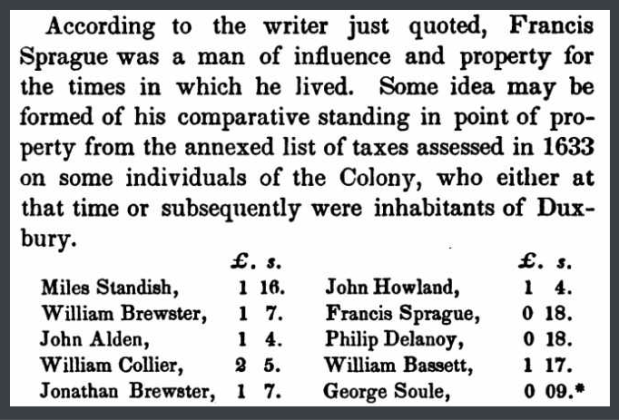
Francis Sprague got to stay. He was a freeman, an innkeeper licensed to sell liquor and he owned land.

screenshot.png

Snapshot from Memorial of the Sprague family by Soule, Richard page 30 at HathiTrust

Israel Dewey b. 1738

Not many details on Israel Dewey (8th great uncle) b. 16 Sep 1738, d. 1806 in Connecticut. Israel may have asked his brother  David Dewey (8th great grandfather) to be his guardian in 1753. Israel’s Probate (on Ancestry.com  Connecticut, Wills and Probate Records, 1609-1999) contains 32 pages or images. There’s a cover page, inventory, assorted notes and this is image 13:

screenshot 3.png

Israel may have been a deacon and may have been married to Bethiah, still searching.


Godsgift Arnold b. 1658 and Jireh Bull b. 1659

Bull, Jireh and Godsgift house

Godsgift Arnold 1st cousin 9 times removed from Elizabeth Speedy who married Stanley Roose Sr.

Godsgift was born on 27 Aug 1658 in Newport, Rhode Island, USA to Benedict (11th great uncle) and Damaris Westcott Arnold, the governor. Benedict Arnold who joined the British Army was her great grand nephew. Godsgift married Jireh Bull, their grandfathers William Arnold and Henry Bull were original Rhode Island settlers in the 1630s. Godsgift and Jireh lived in Newport, Rhode Island in a home still standing, now known as The Captain John Maudsley House. In 1952 it was discovered that the house was actually built by Jireh Bull. The August 27, 1952 Newport News tells the house’s history, I haven’t found the actual source. The Library of Congress has photos and floor plans of this house that Jireh started building in 1680. The house is still standing and privately owned today, at Wikipedia . 

The photo is from early 1900s. Jireh began building in 1680.  At the Library of Congress: John Maudsley House, Other Title Jireh Bull House.

Lewis and Clark Expo James Davis and Mary Ella Gaines Miller 1905

Portland Fair 1905James Davis Miller and Mary Ella Gaines Miller (2nd great grandparents) , in 1905 left Butler County, Iowa for the Lewis and Clark Exposition in Portland, Oregon. Mary Ella’s sisters Florence and Jeanette and maybe a brother were living in Oregon at that time.

PDX History documents the Exposition with photos, postcards, links. The Lewis and Clark Expo on Flickr contains 26 photos one of them the Agricultural Palace which I’m sure JD and Mary Ella visited.

screenshot

Agricultural Palace 1905 Lewis and Clark Expo in Portland.


In June of 1922, Mary Ella and James’s son William with wife Lola (great grandparents), son Faber (grandfather) and daughter Florence (great aunt)  took an auto vacation to Northern Wisconsin. In the 1920s auto travel for the common man was just beginning so this auto trip was pretty big news.

screenshot.png

Frerichs family emigrates in 1883

In 1883 Enno Frerichs (2nd great grandfather) and family sailed from Bremen, Germany to Baltimore, Maryland. From Baltimore they would have taken a train to Freeport, Illinois joining friends and family already settled in America. Railroad companies produced pamphlets many in  German, advertising the lands for sale in the Plains: Illinois, Iowa, Kansas, Nebraska. Local agents were listed along with details about crops, social life, religion and the financial make up of the specific towns. Railroads and the Making of Modern America University of Nebraska Lincoln is an educational site with plentiful sources.


Those SAR and DAR organizations 2016 Jun 30

Sarah Dewey’s (5th great grandmother) parents are in the U.S., Sons of the American Revolution Membership Applications, 1889-1970 for Sarah Witter (mom) and U.S., Sons of the American Revolution Membership Applications, 1889-1970 for Sarah Dewey. These membership apps show Sarah’s parents from the Dewey and Connable families. I’ve not used the SAR applications as sources not sure how true they are. Both these applications are 10+ pages with a lot of ancestry details. I’ll read them and evaluate. I visited the DAR site and after controversies in the 50s and 60s, 70s they now allow non-white persons in their society. They also verify claims, since about 1974. They also offer their records freely through their GRS Genealogical Research System. And the DAR Ancestor Search contains a ton of information on Revolutionary era ancestors.  “The best way to search for ancestors is by last and first name only, no other details. The ancestor number in this search is not the same as the SAR and/or DAR number that you may find in Ancestry.com sources.”

Angell 2016 Jun 23

There’s always more to the story.

Delia Viola Angell Flood (3rd great grandmother) was named in her father Dexter Angell’s will with younger half brother Julius and older sister and brother Elizabeth and Charles. Delia and Julius were ‘infants’ in the law’s eyes, so the lawyer had to arrange guardians. The guardians may have been Henry Haynes and Lewis Angell, brothers of Dexter.

The same Dexter Angell (4th great grandfather) circa 1872 had in his possession “the gold medal awarded by Gen. Lafayette, to Col. Israel Angell.” Israel was Dexter’s grandfather – and Dexter was his favorite, probably how he got that gold medal presented to his grandpa by French revolutionary Lafayette. A note from Israel “N.B. I Remember my love in particular to My little Grandson Dexter, and tell him that his poor old Grandaddy intends (GOD willing) to Come & see him before one year to an End. I. A.”


History and Law, Sources and Evidence

This incredibly helpful and well-written article “Evidence and Sources and How They Differ” by Donn Devine adds another level of confusion to the citation and documentation of citing sources in genealogy. The article is in Ancestry Magazine May/June 1997, available on Google Books.
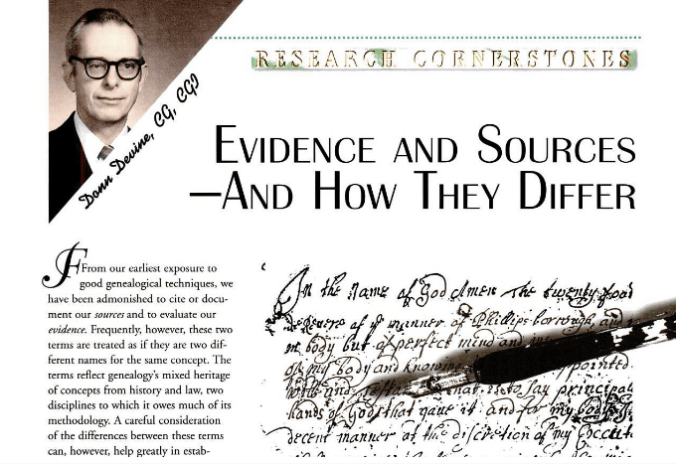
screenshot 2

My summary: The concept of source comes from social sciences, history and is the means by which information comes to a researcher, the container or vessel. Primary sources are the earliest or first pieces of recorded information. Secondary are published works, electronic, copied, compiled or reflecting the conclusion of a researcher.

The concept of evidence comes from law as in wills and probates. Evidence is the physical form in which information is presented to the senses and comes in 3 forms

  • testimonial
  • documentary
  • physical

The testimonial and documentary evidence has to be given with formality or solemnity, like with an oath.

As with a historian’s source , a lawyer’s evidence can vary from reliable to questionable. Courts separate the evidence into inadmissible = not reliable; and admissible = worth considering with varying degrees of reliability.

The term evidence came into genealogy  with the 1979 book Genealogical Evidence by Stevenson. The book encouraged weighing and evaluating evidence. The legal concept of Primary Evidence was also in the book, defined as the best evidence possible.

Genealogists now speak of evidence and primary evidence. There is a tendency to use the term primary source for the material that contributed to the research but not for the evidence or primary evidence the conclusions were based on. When sources and evidence are used together without distinction sources are more likely to refer to secondary sources, and evidence refers to documents used to reach conclusions.

Proof is a name for a process, not the same thing as evidence, not a document or source. Stevenson’s book described levels of proof from his experience as a lawyer

  • absolute
  • beyond a reasonable doubt
  • ‘more probable than not’ the standard applied to most civil court trials.

How evidence is used to prove a point depends on if it directly applies to the issue, or if conclusions are drawn based on relationships to the issue. Direct evidence is a birth record. Indirect evidence is a man receiving an inheritance even though no birth record exists, just a census record with him in the home and the inheritance.

IN summary there are no absolute rules. To avoid confusion think of sources as the published works that lead you to reliable records. Use evidence for the records that support confusion and primary evidence when records are original.


I think genealogy is buried in fussy record keeping. The kind where several bits of punctuation have to be just so for any record to work. Maybe this is based on library cataloging of the 1980s when each and every bit of punctuation had to be entered in a massive string of chronological order designed to make records universally readable. I don’t know, just thinking about it.

When I entered the field of family history in Spring of 2015 I plowed ahead on Family Search.org [FREE] and Ancestry.com [$] clicking here and there, adding records, sources were auto created and cited for me. There was no need to document or cite anything, I thought. When my two trees were at 2000 people each and I was just getting a little concerned about how all these ancestors, records, documents, dates, names, media, citations, sources, how it all came together in an organized, easy to manage library.

In looking at some of the records and sources auto generated by Ancestry.com or Family Tree Maker I saw trouble. A lot of records were auto saved without any kind of source citation. *Anyone that enjoys genealogy knows that records and sources cannot be evaluated without a citation*. I’m reading this highly helpful article for the 3rd or 4th time.
Bradford Hale b. Jan 1844

Bradford Hale 1st cousin 2 times removed or 2 generations back from Elizabeth Speedy who married Stanley Roose.  Bradford Hale on RootsMagic tree.

Bradford Hale was born in Prairieton, Vigo, Indiana. His father’s family, the Hales, and mother’s family, the Angells, were original settlers in Prarieton. Bradford’s grandfathers are featured in the book “History of Vigo and Parke Counties together with historic notes on the Wabash Valley, gleaned from early authors, old maps and manuscripts, private and official correspondence, and other authentic, though, for the most part, out-of-the-way sources” by H. W. Beckwith. Available at the Vigo County Public Library and on Ancestry.com .

In 1862, at age 18 Bradford enlisted and entered the Civil War. He was part of three regiments:
33rd Regiment, Indiana Infantry
54th Regiment, Indiana Infantry (3 months, 1862)
85th Regiment, Indiana Infantry

The 85th regiment “took part in all the operations before Atlanta and was present at its fall. It engaged in the destruction of railroads and also in the building of roads and bridges.”  Source: Index with transcription Historical Data Systems, comp. U.S., American Civil War Regiments, 1861-1866 [database on-line]. Provo, UT, USA: Ancestry.com Operations Inc, 1999.

Bradford ended up at the infamous Confederate Andersonville Prison or Camp Sumter- known for seriously inhumane conditions. Bradford was exchanged the day President Abraham Lincoln died April 15, 1865. The camp was officially liberated May 1865 and today it’s a National Historic site in Georgia, at Wikipedia Andersonville Historic site.

After the war Bradford worked, married later in life and had a daughter. By 1885 he was 44 and a rancher in Chafee Colorado. 

Part of Bradford Hale’s military record at the National Park Service, Civil War Soldiers and Sailors System, online.

Name: Bradford Hale
Enlistment Date: 18 Jun 1862
Rank at enlistment: Private
State Served: Indiana
Survived the War?: Yes
Service Record: Enlisted in Company F, Indiana 54th Infantry Regiment on 18 Jun 1862.Mustered out on 18 Sep 1862 at Indiana

Name: Bradford Hale
Side: Union Regiment
State/Origin: Indiana
Regiment Name: 85 Indiana Infantry.
Regiment Name Expanded: 85th Regiment, Indiana Infantry Company: E
Rank In: Private
Rank In Expanded: Private
Rank Out: Private
Rank Out Ex –

Civil War Trust Saving America’s Battlefields provides maps, photos and great detail on the Civil War.

A copy of Bradford’s headstone application c. 1936. Bradford’s great grandfather was Israel Angell, a Revolutionary War Colonel who wrote to and received letters from General George Washington. I wonder if Bradford knew this.

screenshot

Hale, Bradford. U.S. Headstone Applications for Military Veterans, 1925-1963

National Archives at Washington, D.C.Applications for Headstones,
compiled 01/01/1925 – 06/30/1970, documenting the period ca. 1776 – 1970
ARC: 596118. Records of the Office of the Quartermaster General, 1774–1985,
Record Group 92. National Archives and Records Administration, Washington, D.C.

2016 Jun 21 the 1st major sync error

Creating a tree on Ancestry.com and then syncing to Family Tree Maker (FTM) is not fun and easy. It’s tough and frustrating, like hair-pulling chain smoking frustrating. I’ve had continual issues since purchasing FTM springtime 2015. It is FTM3 for Mac and maybe Mac is not their strong suit? Here’s some photos of the fun and easy syncing issues that began in a really big way on Memorial Day weekend.


Update August 2016- I sync Ancestry.com with FTM3 most every time I work on my tree. I have turned off the auto sync in FTM, use manual sync instead. Each time I sync I double check place names, people, source repositories, citations, citation facts, media, etc. I compact the tree about once a week, or if I’ve done a lot of editing. Since May I’ve had only 1 sync issue- a blip that lasted about 3 days.

I have Roots Magic– even though it looks like 1995 it’s good AND MacFamilyTree– it’s definitely modern. I love MacFamily Tree, well organized and easy to edit media and sources, stories read/narrated about my ancestors and easily produced beautiful colorful easy to read charts and reports. The only down side is the missing sync. Once I get my tree kind of semi-first draft finalized, I’ll import a GEDcom and start something.